

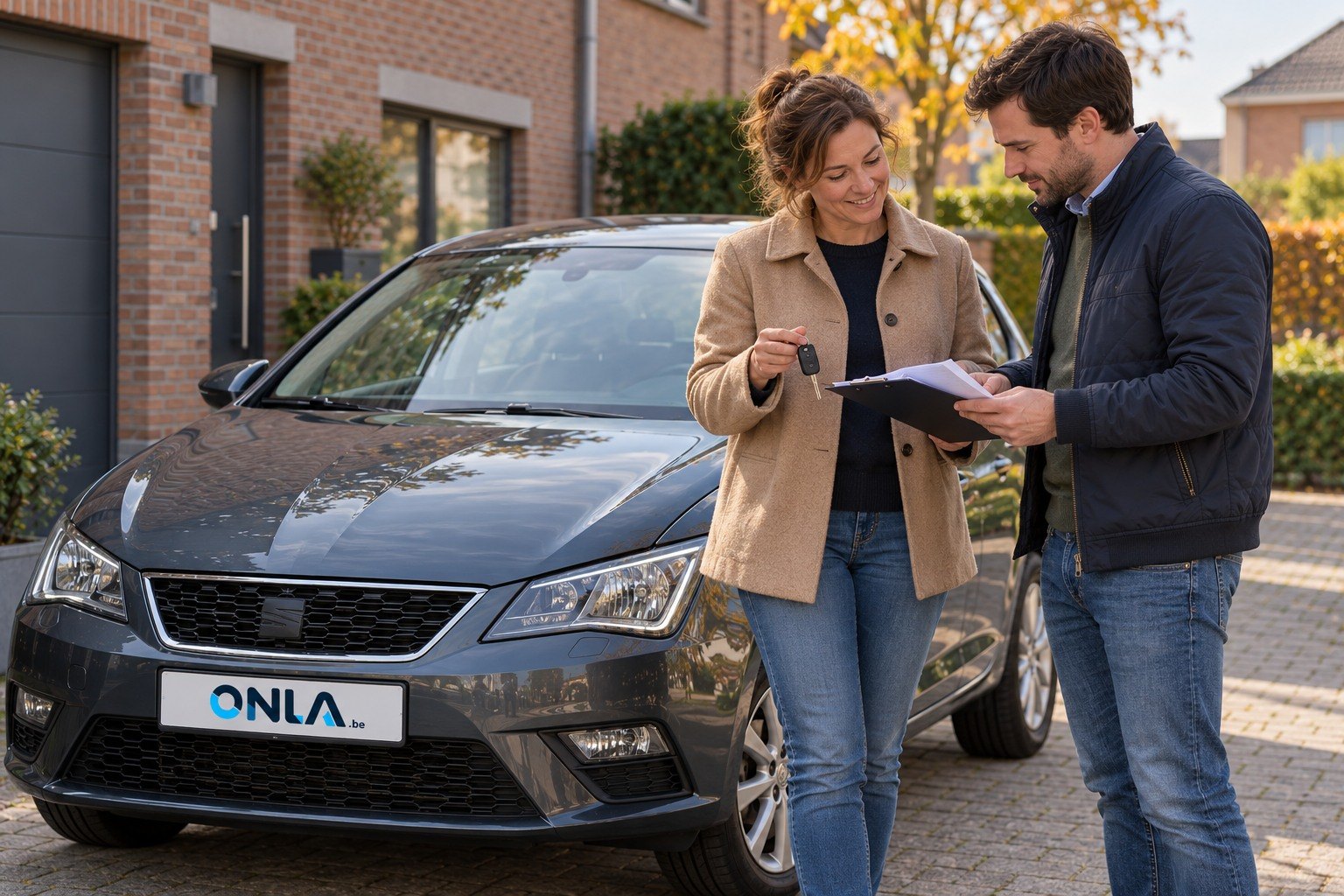
Selling your car privately in Belgium involves more than agreeing on a price. You need to prepare the documents, arrange the test drive, secure payment and plan how the buyer will legally drive the vehicle away.
The right approach: put the paperwork together before the appointment, record the agreement in writing and only hand over the car after checking payment and the arrangements for driving it away. This guide mainly concerns a used car already registered in Belgium, sold by its private owner to another private individual.
Publication date: 5 November 2026. Information checked on 19 October 2026. Additional procedures may apply to exports, imported vehicles, estates or professional sales.
1. Check that you can sell the vehicle
Gather your proof of purchase and check the vehicle’s status before offering it for sale. If the car belongs to a leasing company, several people or an estate, clarify who can sign and what authorisations are needed. If there is outstanding finance, reread the agreement and ask the lender whether any formalities are required.
Compare the chassis number, or VIN, with the documents. If an important document is missing, sort this out first. A promise to send “the rest later” complicates the sale and may prevent the buyer from registering the vehicle.
2. Prepare an accurate and honest advert
State the make, model, engine, gearbox, date of first registration, mileage and equipment actually fitted. Describe recent servicing and known defects: a scratch, faulty air conditioning, an illuminated warning light or a repair that is needed.
To set your price, compare vehicles of a similar age, mileage, equipment level and condition. The asking price in an advert is not necessarily the final sale price. You can browse the passenger car listings on OnLa.be to help with your comparison.
Take clear photos of the exterior and interior without hiding defects. Avoid publishing full scans of documents containing your contact details or signatures. Relevant documents can be shown to an identified buyer during the viewing.
3. Documents to prepare and hand over
Prepare a folder and a handover checklist. The usual paperwork includes the documents below; some depend on the equipment, certificate format or applicable procedure.
| Document | Checks before the appointment |
|---|---|
| Registration certificate | Locate both parts if the certificate has two. |
| Certificate of conformity | Check that it matches the vehicle and its configuration. |
| Vehicle inspection documents | Prepare the certificate and used-vehicle report or the document issued under the applicable procedure. |
| Registration application | Check the validity of the form issued after the inspection. |
| Valid Car-Pass | Check the date, VIN and mileage data. |
| Specific certificates | Include the documents required for the relevant equipment, such as LPG. |
| Servicing and history | Include the service book, relevant invoices and any available proof of purchase. |
| Written sale agreement | Prepare a copy for each party and a list of the documents handed over. |
The list of documents published by Wikifin helps you check your paperwork. The Federal Police specifically highlight the importance of part B of the registration certificate. If a document is missing, ask the DIV or the inspection centre about the appropriate procedure before scheduling the handover.
4. Car-Pass: mandatory even in private sales
When selling to a private buyer, the seller must hand over a valid Car-Pass. It must be no more than two months old. The exception for automotive professionals buying a vehicle does not apply to your private buyer, even if they say they do not need the document.
Record its handover in writing. The contract or an attachment can state the Car-Pass date, its reference and the buyer’s acknowledgement of receipt. If it is not handed over, the buyer can request cancellation of the sale. See the official Car-Pass guidance on the seller’s obligation.
A Car-Pass can be obtained during the vehicle inspection, among other options. You can also request one at a centre by presenting the vehicle so its data can be recorded. Its history helps assess the mileage and recorded work; it is not a guarantee that the vehicle will not break down. The official page for sellers details its contents and explains that handing it over remains mandatory when selling to a foreign private buyer.
5. Vehicle inspection: distinguish between periodic and used-vehicle inspections
In a standard private sale in Belgium in 2026, the vehicle must undergo the inspection required for a change of ownership, unless an applicable exception exists. A periodic inspection that is still valid does not automatically remove this requirement.
A recent inspection may allow a simplified procedure, subject to conditions. Autosécurité explains the distinction. Ask the centre which appointment to book and which original documents to bring.
The registration application issued after the inspection is valid for a limited period, usually two months. Avoid preparing the documents too long before the handover. The official Flemish page on used-vehicle inspections distinguishes between the validity periods of the different documents.
Pay attention to the date of your sale: Flanders has announced a change to the used-vehicle inspection requirement from 1 January 2027. This regional change must not be applied early to a sale in November 2026, nor automatically extended to other regions. Consult the new Flemish rules and have the procedure for your case confirmed.
6. Plan the viewing and test drive in advance
Arrange a daytime appointment in a permitted location where you can examine the documents and vehicle calmly. If possible, bring someone with you. Give the buyer the opportunity to look over the car and ask questions, but keep control of the keys and original documents.
- Check the person’s identity and the validity of their driving licence before a test drive.
- Ask your insurer how a test drive by a prospective driver is covered, particularly for damage to the vehicle and the excess.
- Agree on a route and accompany the buyer if the test drive can take place under suitable conditions.
- Do not let the car leave solely on the basis of an identity document left as security.
- Do not remove a safety component yourself at a visitor’s request.
A valid driving licence does not prove that all damage will be covered by your policy. If you have any doubts about insurance or safety, postpone the test drive. The Wikifin tips for selling your car specifically recommend not letting the buyer take the test drive alone.
7. What to include in the sale agreement
A written agreement signed by both parties clearly sets out the commitments, payment and handover. Prepare a complete copy for each party, with the same attachments.
- Identity and relevant contact details of the seller and buyer.
- Make, model, VIN, first registration and recorded mileage.
- Agreed price, payment method and any amount already paid.
- Known defects described precisely and any repairs promised.
- Included accessories: second key, wheels, charging cables or other items.
- List of documents handed over, including the identified Car-Pass.
- Delivery date and terms; arrangements if a document needs to be brought into order.
- Date, place and signatures.
If you receive money before delivery, specify its purpose, how the vehicle is reserved and the consequences of withdrawing from the sale. Do not assume that the terms “advance payment” and “deposit” always have the effect you expect. Have any special condition checked, such as a sale subject to financing.
A vague phrase such as “car in perfect condition” may contradict a known defect. Use a factual description instead: the symptom observed, any available diagnosis and whether a repair has been carried out.
8. Private sales and warranties: avoid misleading promises
The statutory conformity guarantee applicable to a sale by a business to a consumer does not apply in the same way to a genuine sale between private individuals. The FPS Economy explains this scope of application.
This does not mean that a private seller can conceal a defect or that a “no warranty” statement removes all liability. The rules on hidden defects may apply, with their scope depending on the facts and the valid clauses of the contract. Articles 1641 et seq. of the former Civil Code govern this issue, particularly where the seller knew about the defect.
Disclose known problems in writing and keep the information you have provided. An inspection of the vehicle by the buyer does not automatically turn a hidden defect into an accepted defect. For an exclusion clause or a dispute after the sale, seek legal advice tailored to the case.
9. Secure payment before handing over the keys
Agree on the payment method before the meeting. For a bank transfer, arrange the necessary transfer limit and a fallback if the money does not arrive immediately. Scheduling the meeting for a time when your bank can respond makes checks easier.
Check for yourself that the money has arrived in your usual banking app, opened directly. A screenshot, a bank transfer PDF or the screen of the buyer’s phone does not prove that your account has been credited. The police describe in detail the fake bank transfers shown during vehicle sales.
If payment is claimed but has not arrived, postpone handing over the vehicle. If a payment seems unusual, comes from an unexplained third party or is accompanied by a refund request, ask your bank to check the situation. Do not send an “overpayment” to another account simply on the supposed buyer’s instructions.
Cash raises concerns about security and checking banknotes; a cheque must also be checked with the bank. Do not choose a payment method that you do not know how to verify for that amount.
10. Recognise the most common scam scenarios
- A buyer immediately accepts the price but demands fees for a carrier or delivery insurance.
- A link claims to let you receive the money after entering your banking credentials.
- A message claims that payment is blocked until you pay a fee.
- Proof of a bank transfer comes with pressure to take the car away immediately.
- Someone asks for full copies of your documents before any credible viewing has been arranged.
Safeonweb warns about fake payment links on second-hand marketplaces. To receive a bank transfer, you do not need to disclose your PIN, authorisation codes or online banking credentials.
If you have entered sensitive information on a fake website, contact your bank immediately. Keep the messages and report the incident to the police if you are a victim of fraud. Also notify the platform where the advert was published.
11. Plan how the buyer will take the car away
The sale and permission to drive on public roads are two separate matters. The buyer must arrange valid registration and insurance before driving away, or arrange suitable transport. The FPS Mobility explains the procedure for registering a car.
Do not leave your number plates with the new buyer so they can “just drive home”. Remove your official number plate and its duplicate before the final handover. Agree on the timing with the buyer and your insurer; no promise to return the plates replaces the proper procedure.
If the vehicle cannot legally be driven on the planned day, postpone driving it away or arrange professional transport. A sale abroad requires checking the transport or temporary registration requirements; leaving a Belgian number plate on the car does not solve this problem.
12. After the sale: number plate, insurance and personal data
If you are replacing the car, ask your insurer whether you can reuse your number plate. For another vehicle in the same category, FPS Mobility allows re-registration under the same number within four months. If you need to deregister the plate, follow the DIV’s current procedure.
Since 1 August 2025, the DIV handles deregistration; bpost no longer carries out this operation. The official rear number plate must be sent to the DIV or dropped off at the designated location in Brussels. A postal receipt does not prove that deregistration actually took place on that date. Consult the official deregistration procedure for the details, then check the outcome via My vehicle, my plate.
Inform your insurer of the sale and ask for confirmation of how the policy will be handled. Keep proof of handover and the documents needed in case any questions arise later about a tax or an offence.
Before the vehicle leaves, remove personal belongings and documents. Delete paired phones, contacts, saved destinations and remote access in the manufacturer’s app, following its procedure. Remember any parking passes and remote controls left in the vehicle.
13. An easy-to-check vehicle handover
On the agreed day, go through the checklist together rather than relying on memory:
- The buyer’s identity matches the written sale agreement.
- The VIN, mileage and disclosed defects are recorded correctly.
- The valid Car-Pass and other necessary documents are present.
- The agreed amount has been verified in your account; any banking concerns have been resolved.
- The original documents, keys and accessories handed over are listed, and their receipt is recorded.
- The handover date and time are recorded on both parties’ copies.
- Your number plates and personal data have been removed.
- The buyer’s arrangements for driving or transporting the vehicle are in place.
Keep a copy of the contract, the handover checklist, proof of payment and relevant documents. If the buyer later reports a problem, ask for a written description and technical evidence before taking a position; do not promise a refund without understanding the case.
To prepare your advert and compare similar cars, browse the passenger cars on OnLa. A clear description, a complete set of documents and precise terms of sale make discussions with serious buyers easier.
Discussion
Sign in on the main website to leave a comment.
No comments yet. Start the conversation.