


Scheduled publication: 21 November 2026. Information checked on 21 October 2026. Specifications, warranties and charging options must be checked for the specific vehicle you are considering buying.
A used electric car can meet your needs without offering the range of a new model. But its price and mileage are not enough to assess the purchase. You also need to know the condition of the battery, the charging equipment and the possible costs after delivery.
Before paying a deposit, ask for a recent battery report, check the exact version and test both the car and its charging. A range advertised in a listing, a figure on the dashboard or the words “battery under warranty” are no substitute for these checks.
1. Start with your journeys and charging options
Note your daily driving distance, your motorway journeys and the long trips you actually make. A small battery may suit local journeys with regular charging. It may become restrictive if you need to cover a long distance in winter without charging at your destination.
Before choosing a listing, answer four questions:
- Where will you usually be able to charge: at home, at work or at public charging points?
- Do you actually have a parking space and the permissions needed to install a charging point?
- How much of a detour and how much charging time are you willing to accept each week?
- Does your budget still make sense if you rely mainly on public charging points?
Do not rely on a nearby charging point as your only solution without checking its access, connector, prices and an alternative. If you live in a jointly owned building or rent your home, clarify your installation plans before buying the car.
2. Battery: distinguish between SOH, charge and range
These details describe different things:
| Indicator | What it means | Limitation to bear in mind |
|---|---|---|
| SOC, state of charge | Current charge level, expressed as a percentage | 100% does not mean the battery is as good as new |
| SOH, state of health | Indicator of remaining capacity compared with an original reference value | You need to know the test method and date |
| Displayed range | Estimate of the remaining driving distance | It is not a complete measure of the battery’s condition |
| Capacity in kWh | Amount of energy the battery can store | Gross capacity, usable capacity when new and current usable capacity are not interchangeable |
The Car-Pass guide to SOH explains the value of this indicator when assessing a used car. SOH must be interpreted alongside age, use, measurement method and your needs. A percentage on its own does not predict the remaining lifespan or guarantee freedom from faults.
There is therefore no universal threshold that automatically makes every battery a “good” or “bad” buy. A poorer condition may make the range insufficient for you, even if the vehicle still works. Conversely, adequate capacity does not remove the need to check for faults and review the vehicle’s history.
3. In Belgium, check the SOH on the Car-Pass
Since 2026, sellers have been able to have an SOH reading and its test report included in the Car-Pass. This step is optional. Do not confuse the requirement to provide a Car-Pass for applicable sales with a general requirement to provide a battery certificate.
Scan the QR code and view the digital data. If a report is available, compare its chassis number, date and mileage with the car being offered. If the SOH is not listed, ask for a check before finalising the purchase. Car-Pass explains these steps in its tips for buying a used electric car.
The absence of a certificate is not, on its own, proof of a faulty battery. In practice, it leaves uncertainty that needs to be resolved. Refusal to allow any testing, combined with incomplete documents or contradictory explanations, is reason to put your decision on hold.
4. Ask for a proper report, not just a screenshot
Ask who carried out the test, on which vehicle, using which method and under what conditions. Reading data from the battery management system is not the same as a test using dynamic measurements. The price and scope of the services may also differ.
DEKRA Belgium specifically distinguishes between reading the SOH from the BMS and a dynamic test. Also check that the proposed method is compatible with the model and battery concerned. An app or generic tool does not necessarily give the same result as a suitable diagnostic test.
Before paying for a check, ask for clarification on:
- The information measured and the information simply read from the vehicle.
- The vehicle identification and date that will appear on the report.
- The limitations of the test and the faults it can detect.
- The total price and the conditions for carrying out the test.
A capacity check does not replace a general inspection of the vehicle.ADAC recommends documenting the battery’s condition before buying. Use this result as one part of the vehicle’s records, alongside servicing, the test drive and technical findings.
5. Calculate a practical range with a reserve
WLTP range serves as a benchmark for comparison; it does not guarantee the distance this used car will cover on your route. Cold weather, speed, heating, wind, terrain and tyres affect consumption. A drop in winter range therefore does not automatically mean permanent battery degradation.
The ADAC winter tests illustrate the possible gap between advertised figures and motorway driving in cold weather. Look for tests covering the generation and battery of the vehicle you are considering, then allow a margin.
Example for illustration only: assume a current usable capacity of 54 kWh and two consumption scenarios. The theoretical distance is calculated as follows: available energy divided by consumption in kWh/100 km, then multiplied by 100.
| Energy used in this example | At 18 kWh/100 km | At 23 kWh/100 km |
|---|---|---|
| 54 kWh, representing the entire assumed usable capacity | 300 km | Approximately 235 km |
| 37.8 kWh, representing a window from 80% to 10% | 210 km | Approximately 164 km |
These figures do not describe any particular model and are not a promise of range. The charge window is a calculation assumption, not a universal instruction: follow the vehicle manual. Above all, this example shows why a range calculated down to an empty battery is not a comfortable distance to plan for everyday driving.
During the test drive, note the route, temperature, distance and consumption. A ten-minute drive around town cannot validate a long motorway journey. The explanations from manufacturer Tesla about range also point out that the display in kilometres remains an estimate and that real-world conditions matter.
6. Charging: check the exact version and test the connection
Two cars with the same model name may have different batteries, onboard chargers or fast-charging capabilities. Check the year, trim level, options and technical specifications corresponding to the chassis number.
Charging AC, using alternating current, uses the onboard charger. Rapid charging DC, using direct current, depends on compatible equipment in the vehicle. The power rating shown on a charging station is not the power guaranteed to your car. Tesla explains the role and limitations of the onboard charger for AC charging.
Ask for an AC charging test and, if it matters for your journeys and is available on this version, a DC charging test. Check that the session starts, the connector locks, no warnings appear and charging stops normally. Examine the cables without using damaged equipment.
Low DC charging power during a test does not immediately prove there is a fault. The state of charge, battery temperature and charging station affect the result. Renault describes these limitations and the potential role of preconditioning. Compare like-for-like conditions; for long journeys, charging time over a given range is more useful than an advertised peak.
Finally, check which connectors are actually fitted and which charging stations are compatible along your routes. Some older generations use other standards: for example, the 2023 Nissan LEAF manual mentions CHAdeMO for rapid charging. Do not assume this feature applies to every generation of a model.
7. Battery warranty: read what actually remains
Ask for written confirmation of the warranty applicable to this vehicle: start date, expiry date, mileage limit, capacity threshold, exclusions and transfer conditions. A manufacturer’s warranty does not automatically restart for a full new term when a vehicle is resold.
For example, Tesla Belgium lists eight-year battery warranties with different mileage limits depending on the version and a minimum capacity retention of 70% for the models concerned. The manufacturer specifies that the document supplied with the vehicle takes precedence. This is neither a rule that applies to all brands nor proof that a battery will be replaced for every reduction in range.
If the battery has already been repaired or replaced, ask for the invoice, details of the work and the remaining coverage. Have it clarified whether the replacement component is new or reconditioned. “Battery replaced” alone does not explain its current condition or warranties.
8. Beware of cars with leased batteries
On some older electric cars, the battery may be covered by a separate lease agreement. The price of the car therefore does not necessarily mean that you become the owner of its battery. Renault has notably offered purchase and leasing options, presented on its page on electric vehicles and their batteries.
Ask for proof of ownership or the current contract, then contact the organisation concerned to find out which conditions apply to your purchase. Check the rental fee, any limits, transfer conditions and buyout options. Do not use an old rate found online to draw up your budget.
Have what is included in the sale clearly set out in writing. If the seller says the battery has been bought outright, ask for the corresponding proof.
9. Also inspect the underbody, brakes and equipment
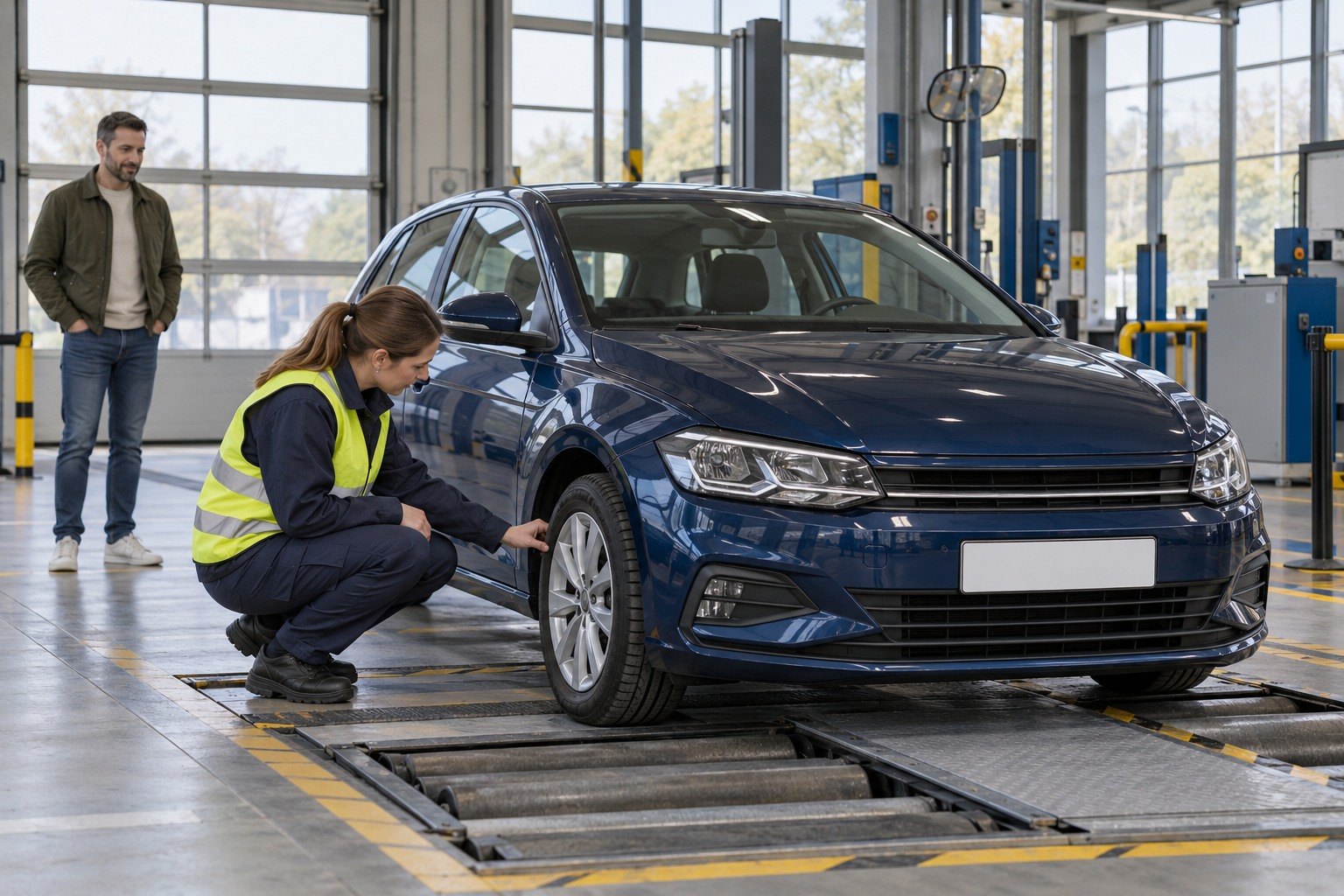
An electric car is still a used car. Check the tyres, suspension, brakes, bodywork and equipment. The Car-Pass general checklist specifically recommends checking wear and testing electronic systems.
Have the underbody and battery protection inspected by a properly equipped professional. Ask for explanations of any impacts, repairs, signs of flooding or warnings. A good SOH is not enough to rule out physical damage. Never open the high-voltage battery pack yourself or handle the orange cables.
Also test the heating, air conditioning, driver assistance systems and keys. Have the low-voltage auxiliary battery checked: it is separate from the traction battery. Ask for details of recorded faults and recommended work, with an understandable explanation of their severity and cost.
10. Documents, history and buyer protection in Belgium
Compare the chassis number on the car, the documents and the reports. Check the seller’s identity, registration, conformity, required roadworthiness inspection documents and available invoices. A successful roadworthiness inspection should not be interpreted as a guarantee of battery capacity.
For sales where this requirement applies, the Car-Pass given to the buyer must be recent: Car-Pass states a maximum validity of two months at the time of sale. Also review the available information on the vehicle’s history, recalls and any post-accident inspections. For an imported vehicle, ask for evidence covering its time abroad.
If you buy from a professional seller for private use, the statutory guarantee of conformity is generally two years; it may be explicitly reduced to one year for second-hand goods. The FPS Economy highlights this distinction from a commercial warranty. Do not assume that all normal wear automatically constitutes a covered defect.
A sale between private individuals does not benefit from this same B2C framework. Keep a detailed contract, the listing and correspondence. For an essential promise, such as DC charging equipment or battery ownership, insist on written confirmation before paying.
11. Calculate the total cost, not just the purchase price
Budget for the pre-purchase inspection, insurance, registration fees and applicable taxes, charging, tyres and any work needed in the short term. Ask for quotes for any faults found. There is no single battery replacement price that applies to all electric cars.
To compare energy costs, use the consumption actually billed when charging, which may include losses, and the rates you expect to pay. Hypothetical example: 20 kWh billed for 100 km costs €6 at €0.30/kWh and €13 at €0.65/kWh. These amounts illustrate a calculation; they are not average Belgian prices. Add subscription, parking or session fees where applicable.
To begin your comparison, you can browse the listings available on OnLa.be. Then compare vehicles with comparable versions, batteries, condition, equipment and warranties. An attractive listing is still only the starting point for your checks.
Before paying a deposit: your final checklist
- Does the battery actually belong to the seller, or has its contract been clarified?
- Is the SOH report recent, identifiable and understood?
- Does the range, with a safety margin, suit your journeys, particularly in winter?
- Have charging and connectors been checked for this version?
- Are the general inspection and underbody examination satisfactory?
- Have the documents, repairs and recalls been checked?
- Are the remaining warranties and immediate costs documented?
- Does the contract include the factors that are decisive for your decision?
If an essential point remains uncertain, have it checked before committing. A good purchase is a car whose current capabilities, documents and cost match your needs, with evidence clear enough to make a decision.


Discussion
Sign in on the main website to leave a comment.
No comments yet. Start the conversation.