

Scheduled for publication on 17 November 2026. Information checked on 21 October 2026 with Belgian authorities and traffic management services.
Is your car losing power, a tyre deflating or the engine stopping on the motorway? The priority is to protect people, then report your precise location. Do not start by looking for the cheapest garage or trying to make repairs beside the traffic lanes.
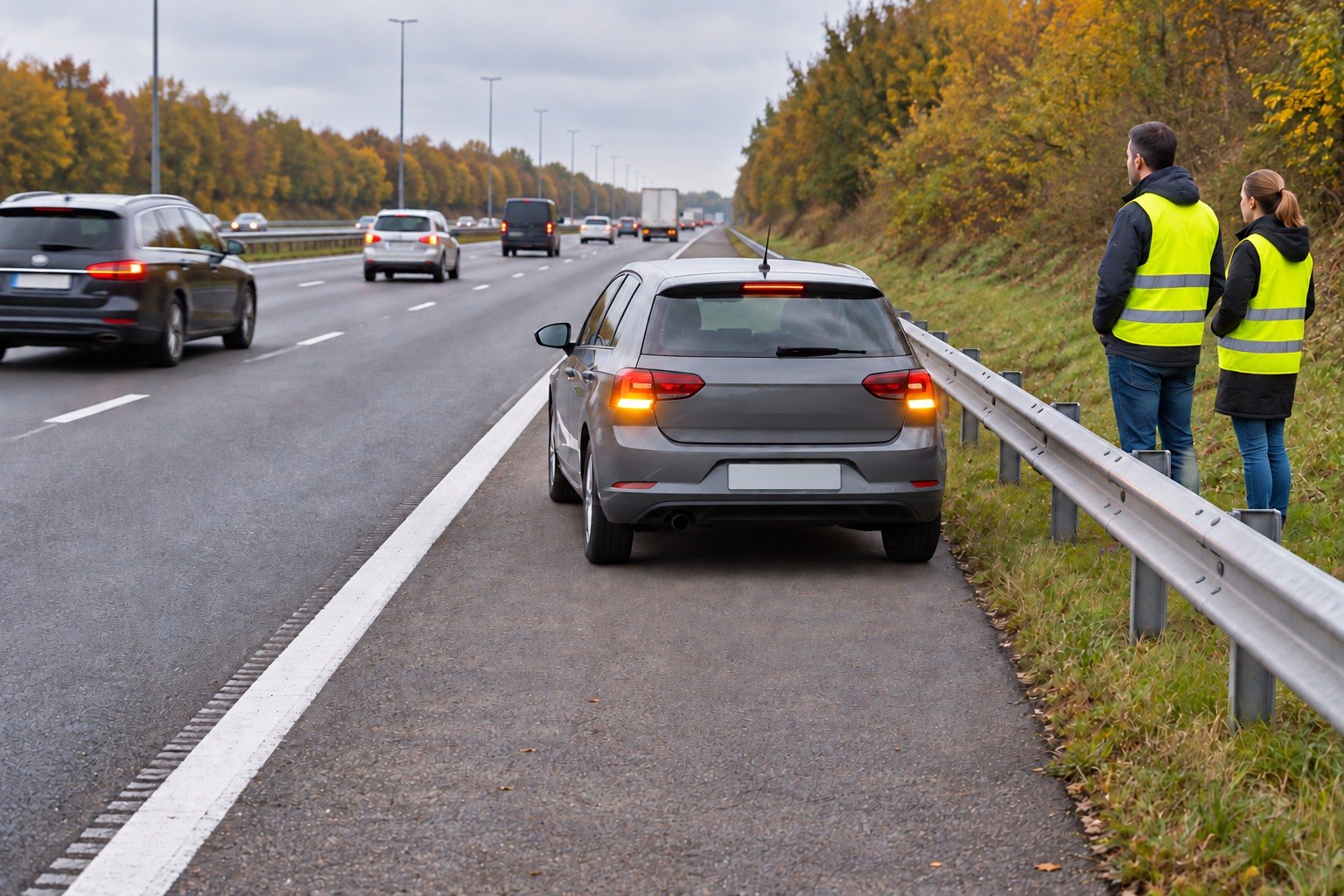
Key points: switch on your hazard warning lights, stop outside the traffic lanes if possible, put on a high-visibility vest before getting out and take shelter behind the safety barrier when it is safe to reach it. Call 112 for an emergency requiring an ambulance, firefighters or rescue. For a breakdown on Flemish motorways or the Walloon network covered by SIABIS+, call 101 to arrange the designated response.
1. Who should you call in each situation?
| Situation | Who to contact first |
|---|---|
| Injuries, fire, trapped people or a need for rescue | 112: state the nature of the emergency immediately |
| Vehicle immobilised in a traffic lane or a hazard requiring police assistance | 101; state immediately that traffic is at risk |
| Breakdown on a motorway in Flanders, including on the hard shoulder | 101: the police activate the F.A.S.T. service |
| Car weighing less than 3.5 tonnes on a covered Walloon motorway or equivalent road | 101: recovery arranged through SIABIS+ |
| Breakdown posing no danger, with the vehicle properly parked in a permitted space | Your breakdown assistance provider or insurer, depending on your contract |
The official 112.be website points out that 112 is not for ordering a tow truck for a breakdown that poses no danger. In an emergency, describe what has happened rather than wasting time choosing between services: the operator will direct you.
2. At the first signs of a breakdown: reach a less exposed location
Switch on your hazard warning lights and avoid sudden manoeuvres. If the vehicle’s condition still allows you to reach a service area, car park or emergency refuge safely, choose that option. Do not keep driving at all costs to reach the next exit.
If you have to stop on the hard shoulder, pull over as far to the right as possible. The Federal Police outline the precautions to take on the hard shoulder, which remains exposed to collisions. Do not reverse to get back to an exit and never make a U-turn.
Once stopped, do not try to push the vehicle off a high-speed road. If you are still in a traffic lane, report this position at the very start of the call: responders need to know that there is an obstacle in the traffic.
3. Leave the vehicle and get passengers to safety
The driver must put on a high-visibility vest before leaving the vehicle in the motorway situation covered by this requirement. Keep it within reach inside the vehicle. A vest for each passenger is also a useful precaution, although the Belgian requirement mentioned here applies to the driver.
Get out on the side away from traffic whenever possible. Help passengers reach a protected area without lingering around the boot or between the vehicle and the traffic lanes. The police advise moving away and going behind the safety barrier where one is present: see their practical advice for motorway breakdowns.
If getting out would expose you directly to vehicles, do not attempt to cross. Call immediately, explain that you cannot evacuate safely and follow the operator’s instructions. Mention anyone with reduced mobility, any children or any particular difficulty. If there is a fire or a need for rescue, call 112.
Luggage can wait. Take your phone if it is accessible, but do not go back for belongings if this means exposing yourself to traffic again. Keep children close to you in the protected area.
4. Do you have to place a warning triangle on a Belgian motorway?
Yes: unlike advice intended for some other countries, Belgian authorities remind drivers to place the warning triangle at least 100 metres behind the vehicle, to warn approaching drivers. A permitted parking space where the vehicle does not obstruct traffic is a different situation.
The Federal Police explain when to use a warning triangle and high-visibility vest. To reach the place where you will put the triangle,AWSR recommends walking behind the safety barrier rather than on the hard shoulder.
Never cross traffic lanes to place or retrieve the warning triangle. If the layout makes placing it dangerous, get everyone to safety and report this difficulty to the police immediately. This safety priority does not turn the legally required distance into a shorter distance chosen at random.
5. Provide a usable location
“I’m near Brussels” or “between Namur and Liège” does not always allow a team to be sent to the correct side of the road. From your safe location, gather the available information:
- The motorway or road number: E40, E411, R0 or A12, for example.
- Your direction of travel, including a destination city.
- The kilometre marker, if visible without moving into danger.
- The last exit you passed, an interchange, a car park or an identifiable tunnel.
- Your position: traffic lane, hard shoulder, emergency refuge or parking space.
- The number of people, any injuries and any evacuation difficulties.
- The vehicle’s description, its registration number and your callback number.
Fictional example: “My car has broken down on the E411 towards Namur. We are on the hard shoulder after the exit I just mentioned. Two people are behind the safety barrier, and no one is injured. I cannot see the kilometre marker from where we are.”
Do not set off on foot to find a kilometre marker to fill in missing information. Say what you know and let the operator help you pinpoint the location.
The 112 BE app can help with an emergency call
Theofficial 112 BE app lets you select police, ambulance or firefighters and sends location information to control centres. Install it and fill in your details before a journey, rather than during a dangerous situation. Even with location sharing, confirm the road and direction of travel when the operator asks.
6. In Flanders: the F.A.S.T. scheme
For a breakdown on a Flemish motorway, the official guidance on Vlaanderen.be is to call 101, whether the vehicle is in a traffic lane or on the hard shoulder. The police dispatch a F.A.S.T. recovery operator, under a scheme designed to make the scene safe and clear it quickly.
Then notify your breakdown assistance provider and explain that recovery has already been arranged. Avoid ordering a second team yourself: ask the services involved to coordinate the next steps. Clearing the motorway and final transport to a garage may be two separate stages.
The Vlaams Verkeerscentrum explains F.A.S.T. charges : rates are regulated, but the vehicle owner is responsible for the bill, with possible reimbursement depending on their insurance. Some policies cover these costs; others do not. Traffic safety signage may also be charged under the scheme’s rules.
7. In Wallonia: vehicle recovery through SIABIS+
The official Walloon procedure, updated on 24 September 2026, specifies calling 101 to contact SIABIS, giving the road, kilometre marker and direction of travel.
The scheme covers vehicles weighing less than 3.5 tonnes, including cars, motorcycles and vans, on the motorways and equivalent roads concerned. It applies whether or not you have a breakdown assistance contract. Do not automatically assume these arrangements apply to heavy goods vehicles or to all ordinary roads.
Once everyone is safe and the breakdown has been reported, contact your breakdown assistance provider to open a case and clarify what is covered. Give the location, registration number and details of the recovery already arranged.
Do not rely on an old price list found online to determine the current cost. Ask for a breakdown of the service: removal, any traffic safety signage, destination, additional kilometres and storage. A service arranged through a public scheme is not automatically free.
8. Brussels Ring, urban roads and tunnels: describe the exact location
The name “Brussels Ring” is not enough to identify which arrangements apply: give the road, direction of travel and exact location. If a vehicle is exposed to traffic or is dangerously obstructing it, call 101; if there are injuries, a fire or a need for rescue, call 112. For a breakdown that poses no danger in a permitted parking space, contact your breakdown assistance provider.
In a tunnel
If the vehicle can still leave the tunnel safely, do so. Otherwise, stop as close as possible to the edge or wall, switch on the hazard warning lights and turn off the engine. Follow the signs, announcements and the operator’s instructions. Never attempt a U-turn.
The tunnel safety instructions from Agentschap Wegen en Verkeer explain emergency procedures and equipment. An emergency telephone accessible via a protected route can connect you directly to the tunnel operator. Do not cross live traffic lanes to reach it. In the event of a fire, move away from danger, use the signposted evacuation routes and call 112.
9. What to avoid while waiting
- Changing a wheel or setting up a jack on the side facing traffic.
- Opening the bonnet and leaning over the engine at the roadside.
- Crossing the motorway to reach a service area or a telephone.
- Asking someone you know to tow the car with a rope.
- Walking to a petrol station with a fuel can.
- Returning to the vehicle to wait more comfortably when a protected area is accessible.
- Taking photos from the carriageway or staying by the boot to discuss costs.
The Federal Police specifically advise against risky repairs and note that the old emergency roadside phones have been removed from the open-air motorways concerned. Do not go looking for them; dedicated tunnel equipment is a different matter.
Remain reachable and report any worsening of the situation: smoke, an injury, a vehicle being moved or a change in where you are waiting. Only return to the car when it is safe for assistance to take place and in accordance with the instructions you have received.
10. Who pays for towing?
Do not confuse motor third-party liability insurance with breakdown assistance. To find out what will be reimbursed, ask your insurer to check your policy and the circumstances. Cover may include limits on distance, destination, costs or the number of call-outs. FPS Economy outlines assistance cover, the scope of which depends on the policy.
Ask specific questions once you are safe: is the initial recovery covered? Where will the vehicle be taken? Is transport to your usual garage included? What arrangements are there for passengers? Is a replacement vehicle or a return home provided?
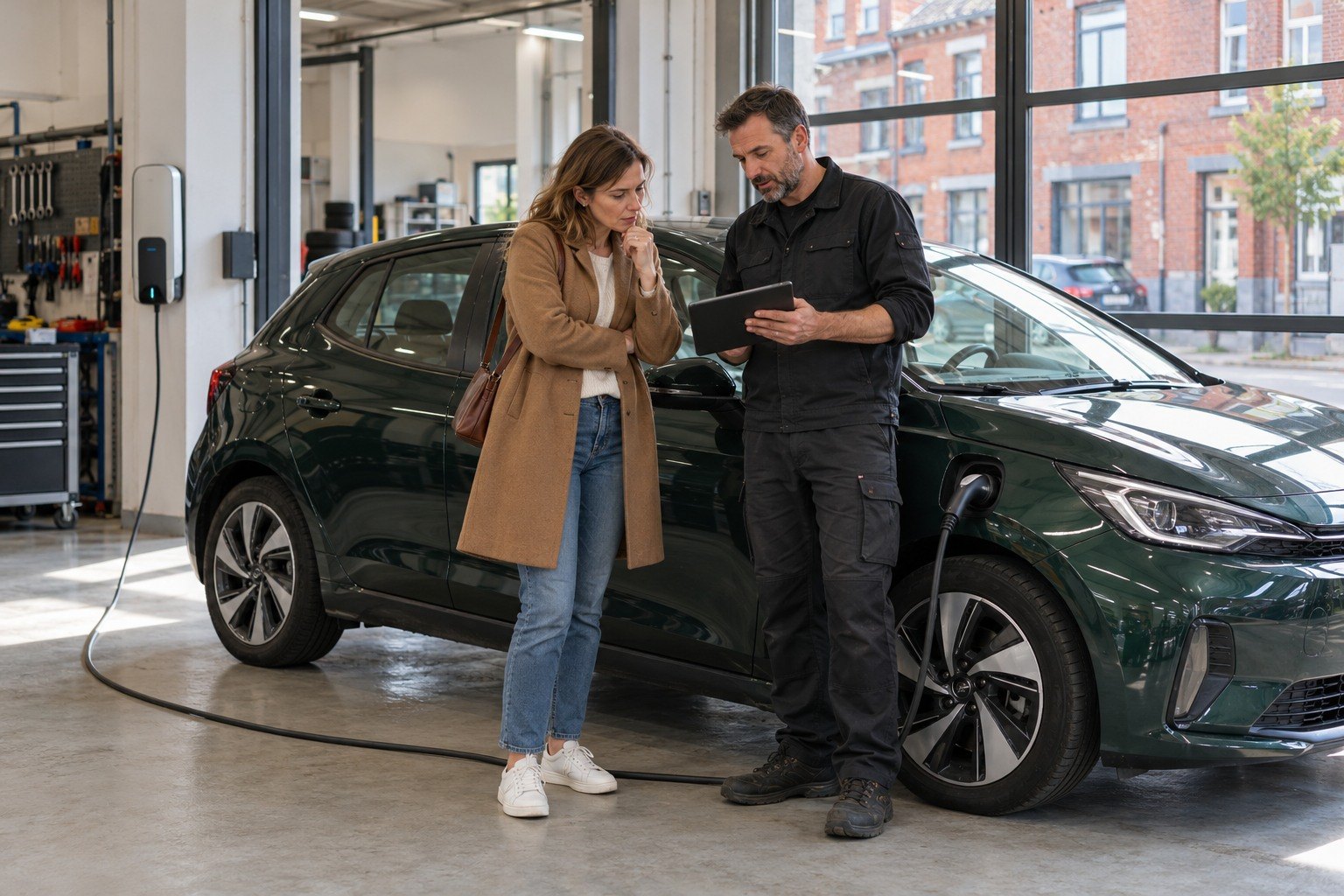
Keep the case reference number, the name of the appointed company, the destination and the itemised invoice. Mention if it is a rental car, a company vehicle or an electric car: arrangements and instructions from the owner or manufacturer may differ.
There is no single price that applies to all breakdowns in Belgium. The time, road network, work involved and destination affect the bill. Compare the charges with the applicable rules and your cover, without delaying urgent safety measures to negotiate on the spot.
11. After recovery: arranging repairs
Before any major repair, ask for a diagnosis and a detailed quote. Check what has been authorised: having the vehicle taken to a garage does not necessarily mean you have agreed to all the work it proposes.
To subsequently find a professional or a replacement vehicle to buy, you can browse the listings available on OnLa.be. This search should take place after you are safe; it does not replace emergency calls or breakdown assistance arranged on the motorway.
12. Prepare the car before your next journey
- Keep the driver’s high-visibility vest in the passenger compartment and provide vests for passengers.
- Check where the warning triangle is and practise unfolding it while parked.
- Save the assistance contact details and keep your policy details accessible.
- Charge your phone and have a way to recharge it.
- Check the tyres, dashboard warnings and maintenance before a long journey.
- Keep a blanket or warm clothing within reach, without having to empty the boot.
The essential response: protect people, establish the vehicle’s location and call the appropriate service. The hard shoulder allows you to stop; it is not a safe place to carry out repairs or wait beside the car.
Discussion
Sign in on the main website to leave a comment.
No comments yet. Start the conversation.