

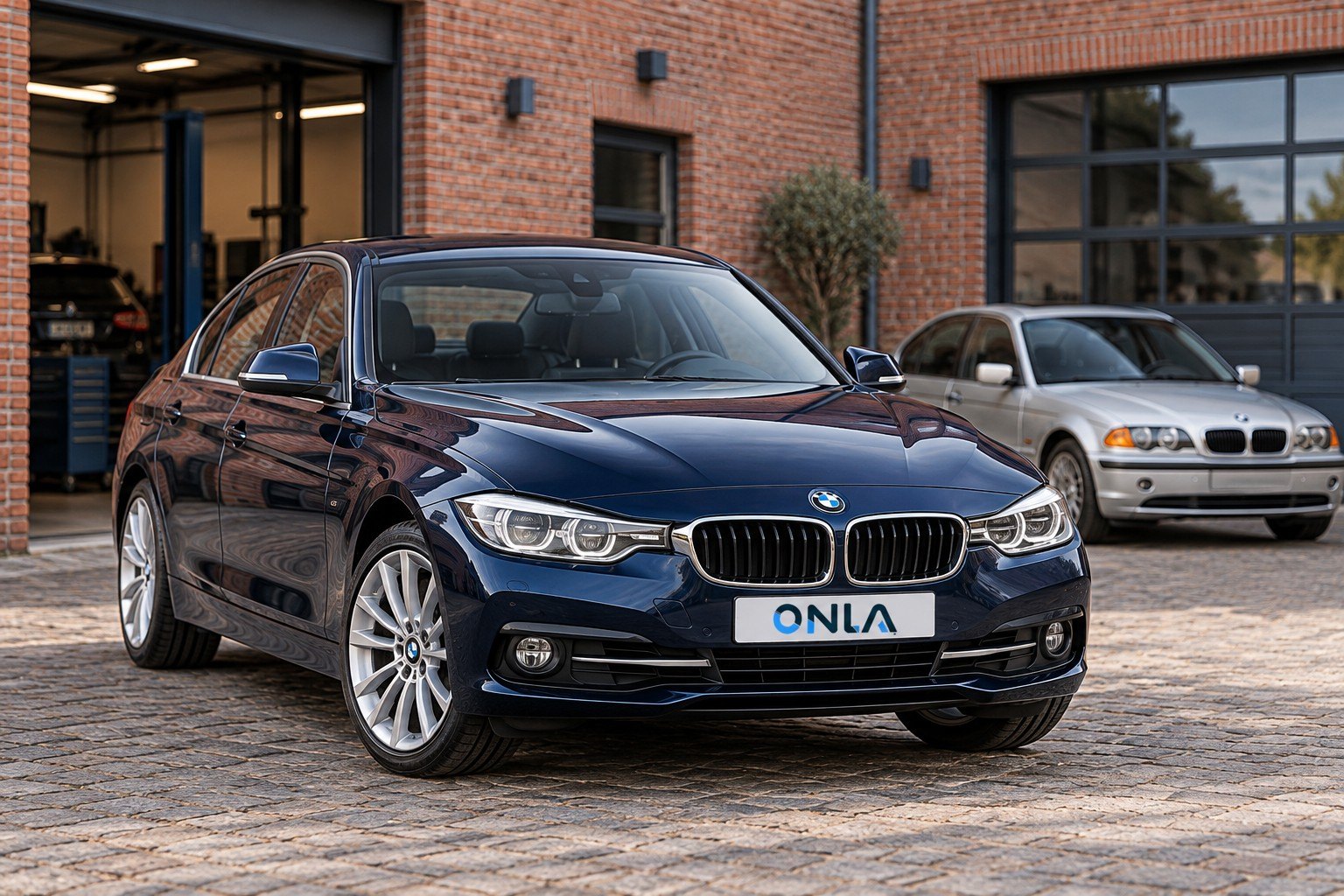
A 2013 BMW 320i and a 2017 320i may carry the same badge without having the same engine. A 3 Series and an X3 may share an engine family without achieving the same reliability results. To buy a used BMW, you therefore need to choose a generation, an engine variant and a specific car.
This guide reviews the main BMW families sold in Europe since 2000, including those launched before that date and still sold afterwards. It distinguishes preferred versions, documented risks and models with insufficient long-term evidence. It does not claim to list every trim, limited edition, gearbox combination or variant reserved for another market.
Research closed on 8 October 2026. The periods are generation reference points: launch, production and first delivery may differ by body style and country. The chassis number remains decisive.
Which BMW should you consider first?
Our first starting point for a versatile purchase is a petrol 3 Series with a complete service history. On a mid-range budget, a facelift F30/F31, particularly a 320i or 330i with a confirmed B48 engine, is worth comparing. With a larger budget, a petrol G20/G21 is another option. This is an editorial selection based on the evidence below, not proof that every B48 is superior to all other engines.
| Need | Versions to compare | Why, and limitations |
|---|---|---|
| Versatile saloon or estate | Facelift 320i/330i F30/F31, around 2015–2019; petrol G20/G21 from 2019 | The 2015 facelift introduces a new engine family. The What Car? owner guide describes the recent 3 Series favourably. BMW: 2015 engines ; What Car?: BMW guide. |
| Recent compact car | 1 Series F40, 2019–2024; choose power output according to use | Favourable owner result at generation level, without identifying a winning engine. What Car? survey. |
| Six-cylinder enjoyment | 340i F30/F31 with B58, from 2015; older 130i with N52 | BMW identifies the B58; ADAC rates the six-cylinder engine in the first 1 Series favourably. A choice for character, not a statistical ranking by engine. B58 documentation ; ADAC petrol 1 Series report. |
| Older executive car | Six-cylinder 528i/530i F10, up to autumn 2011, depending on version | Historical ADAC recommendation. Confirm the engine: a later 528i may have a four-cylinder N20. ADAC petrol 5 Series report. |
| Compact electric car | i3 I01, 2013–2022, battery suited to your journeys | Favourable breakdown indicator; remaining capacity, charging and vehicle condition must be assessed separately. ADAC 2026 statistics. |
To prepare a shortlist of three or four cars, you can browse the BMW listings on OnLa. Above all, compare invoices, the exact engine variant and repairs already carried out, before wheels or styling packages.
What owners and statistics really say
The results below answer different questions. An owner survey collects problems experienced, including those that do not immobilise the car. Breakdown statistics measure callouts covered by their methodology. A technical bulletin confirms an issue or procedure within a specific scope. None of these documents guarantees an individual car.
| Source | Usable finding | What it does not allow you to conclude |
|---|---|---|
| Test Achats, publication dated 19 January 2026 | Survey conducted in spring 2025 in ten European countries, including Belgium. BMW is ranked 12th in the brand ranking presented. Method and results. | BMW’s ranking does not individually rank the N52, B48 or B58. |
| What Car? / MotorEasy, family cars section | The 2019–2024 1 Series is rated at 97.6% in the version consulted. 1 Series result. | This is a reliability index, not the percentage of cars without breakdowns; it is not proof for every engine. |
| What Car?, used BMW guide | The guide gives 97.5% for the recent petrol 3 Series and 96.0% for the diesel. Guide and results. | These figures belong to the cited guide; they should not automatically be relabelled an “annual 2026 ranking”. |
| What Car?, 2026 survey, published on 30 September | The 2018–2024 petrol X3 receives 73.5%. This is a reason for caution over the petrol G01, despite the reputation of some engine variants. 2026 survey. | This result does not identify every engine code and does not condemn all X3s. |
| ADAC, statistics published in April 2026 | Analysis of 2025 breakdown callouts for vehicles registered from 2016 to 2023; several BMW families show good results, including the 1, 3 and 5 Series. ADAC scope. | A failure dealt with in a workshop or an expensive fault without a breakdown callout is not necessarily represented. |
| MotorEasy, warranty data | Indicators based on repairs and their costs. Useful as a reminder that reliability and repair bills are two separate matters. BMW data. | A component’s share of claims is not the proportion of all cars that will suffer that failure. |
The key caution: do not combine an old survey, recent breakdown statistics and a forum testimonial to create a single score. Results pages may be updated. Full access to some What Car? articles is restricted; the figures quoted here are limited to publicly identifiable results, without inventing the sample size for a particular engine.
BMW engines: good candidates and versions to watch
The codes below refer to families, with variants and internal revisions. Two engines sharing the first part of their code may differ. Ask BMW or the specialist carrying out the inspection to confirm the full code and manufacturing date using the VIN.
| Family and indicative period | Buying assessment | Key check and source |
|---|---|---|
| N52: naturally aspirated six-cylinder petrol, mid-2000s | Worth considering on models genuinely fitted with it; for example, the 130i. A good older enthusiast candidate, without an “indestructible” promise. | Full age-related inspection and history check. Do not confuse it with the N53 or N54. BMW technical manual ; ADAC assessment. |
| B48: turbocharged four-cylinder petrol; in the facelift European 3 Series from 2015 | An editorial choice to compare in the 320i/330i, rather than an older N20 with uncertain records. | Check the variant, maintenance and cooling system. The absence of the cited N20 issue does not mean the absence of all faults. BMW launch documentation. |
| B58: turbocharged six-cylinder petrol; debut in the 340i in 2015 | Worth considering if running costs fit your budget; favour a documented, unmodified car. | Inspection and diagnostics; no cited source proves that all B58s are free of faults. BMW B58 manual. |
| B47/B57: diesels from more recent generations | Worth comparing for appropriate use; no universal “best BMW diesel” ranking is established here. | Identify the engine, check the emissions-control system and check campaigns by VIN. BMW Belux: EGR campaign ; BMW check. |
| N47: four-cylinder diesel, around 2007–2015 depending on model | Extra vigilance over the timing system; reject a suspicious example without a diagnosis. | FAI documents chain issues, particularly on early revisions. This supplier also sells kits: its technical documentation is not an independent survey. FAI, bulletin TB0092. |
| N20/N26: turbocharged four-cylinder petrol, affected production mainly 2011–2015 | Avoid without checking if the vehicle falls within the scope of the chain issue. A documented repair changes the assessment. | BMW documents wear of the timing chain and oil-pump chain. Dates vary by model, with some extending to summer 2015. BMW SIB 11 03 17. |
| Original N63: twin-turbo petrol V8, late 2000s and early 2010s | The cautious choice: walk away if the history and mechanical assessment are incomplete. | BMW describes diagnostics and repairs for oil consumption on the affected vehicles. Do not extend this documentation to all later N63s or to S63s. BMW N63 bulletin. |
The N20/N26 and N63 bulletins come from BMW North America and are published by the US NHTSA. They document technical issues; they do not automatically create an entitlement to coverage in Belgium. The N20/N26 document describes a warranty extension, not a general recall. Have exact applicability checked by VIN.
For the other older families — M43/M52/M54, M47/M57, N42/N46, N43/N53, N54/N55, N57, N62/N73/N74 — we do not assign an invented overall score. The exact specification, condition, maintenance and campaigns must be examined for the chosen version. The BMW petrol engine manual helps explain the differences between families in particular; it does not measure their failure rates.
Catalogue since 2000: 1 Series to 8 Series
Each row offers buying guidance. “Worth considering” means that a checked example deserves comparison. “Caution” flags a documented issue or a necessary check; it does not condemn an entire generation. Where no robust comparison is available, we say so rather than artificially identifying a good and a bad version.
| Model and generations | Worth considering | Cautions and sources |
|---|---|---|
| 1 Series E87/E81 from 2004; E82 coupé/E88 convertible until 2013 | N52-powered 130i worth considering as a documented enthusiast purchase. | N47 diesels: check the timing system. The earliest generations are now purchases heavily influenced by age. ADAC generations ; Source for the guidance. |
| 1 Series F20/F21, 2011–2019; facelifts in 2015 and 2017 | For a practical search: compare facelift petrol versions, with the engine confirmed; M140i B58 for enjoyment with a suitable budget. | Older N47 diesels: targeted check. No owner score valid for every engine variant. ADAC generations ; Source for the guidance. |
| 1 Series F40, 2019–2024; F70 from 2024 | F40: favourable owner feedback; compare 118i/120i according to needs and availability. | F70: long-term evidence is still limited; no winning engine has been demonstrated. ADAC generations ; Source for the guidance. |
| 2 Series Coupé/Convertible F22/F23, 2014–2021; G42 Coupé from 2021/2022 | 230i B48 or M240i B58: editorial candidates after inspection, without a specific ranking. | Older 228i N20: check whether it falls within the scope of the chain issue. G42 and M2 models do not automatically inherit an F22 score. ADAC generations ; Source for the guidance. |
| 2 Series Active Tourer / Gran Tourer F45, 2014–2022; F46, 2015–2022; U06 Active Tourer from 2022 | Choose according to usable space, fuel type and confirmed engine specification; no winner by engine has been established. | Hybrids: charging test and battery assessment. Diesel: check campaigns. ADAC generations ; Source for the guidance. |
| 2 Series Gran Coupé F44, 2020–2024; F74 from 2025 | Compare petrol versions according to budget; this range is distinct from the G42 Coupé. | Insufficient long-term evidence to crown an F74 version. Do not transfer the Coupé’s results. ADAC generations. |
| 3 Series Compact and E46 E36 Compact still available in 2000; E46 saloon, Touring, coupé, convertible and Compact, 1998–2006 depending on body style | Six-cylinder petrol models worth considering as older-car purchases after expert assessment; no current ranking by engine. | Age and overall condition dominate. No badge removes the need to inspect the bodywork and running gear. ADAC generations. |
| 3 Series E90/E91/E92/E93 2005–2014 depending on body style; facelifts from 2008 | ADAC rates the six-cylinder engines and the results of facelift examples favourably. | N47 diesels: timing system. Confirm the engine in 325i/330i models and inspect 335i models separately. ADAC generations ; Source for the guidance. |
| 3 Series F30/F31 and GT F34 2012–2019 for saloon/Touring; GT 2013–2020 | 320i/330i B48 after the 2015 facelift; 340i B58 if the budget is suitable. | Older N20/N26-powered 320i/328i: documented risk; some N47 diesels need checking. ADAC generations ; Source for the guidance. |
| 3 Series G20/G21 From 2019; facelifts in 2022 and 2024 | Petrol: an option supported by the owner guide; compare 320i/330i. | 330e: assess the entire hybrid system, not just the petrol engine. G50/G51 announced for 2027: no used-car track record. ADAC generations ; Source for the guidance. |
| 4 Series F32/F33/F36, 2013–2021 depending on body style; G22/G23/G26 from 2020/2021 | First-generation 430i B48 and 440i B58: options after confirming the fitted engine. | Older N20/N26-powered 428i: check whether it falls within the scope of the chain issue. M4 versions require separate assessment. ADAC generations ; Source for the guidance. |
| 5 Series E39 and E60/E61 E39 until 2003/2004; E60/E61, 2003–2010 | Older-car purchase: prioritise the best records; no current statistical winner by engine. | Late-generation E60 520d N47: timing system; identify the diesel engine precisely. ADAC generations ; Source for the guidance. |
| 5 Series F10/F11 and GT F07 F10/F11, 2010–2017; GT F07, 2009–2017 | Six-cylinder 528i/530i up to autumn 2011: historical ADAC recommendation. | Later N20-powered 528i and 550i with the original N63: targeted caution; confirming the engine is essential. ADAC generations ; Source for the guidance. |
| 5 Series G30/G31 and G60/G61 G30/G31, 2017–2024 depending on body style; G60 since 2023, G61 since 2024 | Petrol G30 520i/530i or 540i: worth comparing with history and inspection; editorial choice. | G60/G61: less long-term evidence. Do not equate 530e models with petrol-only versions. ADAC generations. |
| 6 Series Coupé/Convertible/Gran Coupé E63/E64, 2003–2010; F12/F13/F06, 2011–2018 | Compare six-cylinder models rather than choosing solely on high power output; no winning engine has been proven. | 650i: precisely identify the V8 generation and history. The original N63 documentation does not apply to all V8s. ADAC generations ; Source for the guidance. |
| 6 Series GT G32, 2017–2023 | Choose the engine variant according to use; no engine ranking is adopted here. | Inspect the entire vehicle and its equipment; diesel: campaigns by VIN. ADAC generations ; Source for the guidance. |
| 7 Series E38 until 2001; E65/E66 2001–2008; F01/F02 2008–2015; G11/G12 2015–2022; G70 since 2022/2023 | A six-cylinder model may meet your needs; no generation is declared “risk-free”. Inspect all equipment. | 750i with the original N63: caution. V12s and older luxury saloons: specialist purchases, insufficient data for a universal verdict. ADAC generations ; Source for the guidance. |
| 8 Series G14/G15/G16 from 2018/2019; facelift in 2022 | 840i: a comparison option for those seeking a six-cylinder model, without proof of statistical superiority over the 850i. | M850i and M8: do not equate their engines or budgets; no robust ranking by version in the selected sources. ADAC generations. |
BMW SUVs: X1 to X7 and XM
An SUV should not automatically receive the recommendation given to a saloon using a related engine. Weight, drivetrain, equipment and owner feedback must also be examined. The petrol X3 G01’s result in the 2026 survey illustrates this limitation.
| Model and generations | Worth considering | Cautions and sources |
|---|---|---|
| X1 E84, 2009–2015; F48, 2015–2022; U11 from 2022 | Petrol F48: an option to compare; identify the engine and gearbox without extrapolating a 1 Series score. | E84 28i N20: scope of the chain issue. Older N47 diesels: targeted inspection. ADAC generations ; Source for the guidance. |
| X2 F39, 2018–2023; U10 since 2024 | F39: compare documented examples according to use; no winning engine has been demonstrated. | U10: less long-term evidence. Do not confuse the combustion-engine X2 with the iX2. ADAC generations. |
| X3 E83, 2003/2004–2010; F25, 2010–2017; G01, 2017–2024; G45 since 2024 | Each generation requires its own inspection; no blanket recommendation that “an X3 with B48/B58 = a safe purchase”. | F25 28i N20: chains. Petrol G01: unfavourable signal from the 2026 survey. G45: limited long-term evidence. ADAC generations ; Source for the guidance. |
| X4 F26, 2014–2018; G02, 2018–2025 | Compare engine variant, history and condition; no statistically best version is established here. | F26 28i N20: check whether it falls within the scope of the chain issue. X4 M: separate expert assessment. ADAC generations ; Source for the guidance. |
| X5 E53, 1999/2000–2006; E70, 2006/2007–2013; F15, 2013–2018; G05, 2018–2026; G65 unveiled in 2026 | Six-cylinder G05: a candidate depending on your needs, not a promise of low costs. Choose based on a full assessment. | E70 50i with the original N63: extra caution. New G65: no used-car reliability verdict. ADAC generations ; Source for the guidance. |
| X6 E71, 2008–2014; F16, 2014–2019; G06 since 2019 | Compare documented six-cylinder examples; a choice based on needs and budget, not an absolute ranking. | E71 50i with the original N63: assessment essential. Do not confuse M and non-M versions. ADAC generations ; Source for the guidance. |
| X7 G07 since 2018/2019; facelift in 2022 | A six-cylinder model may be sufficient; check every function and estimate maintenance costs. | No universal “bad year” has been proven. Have cars with incomplete records assessed by an expert. ADAC generations. |
| XM G09 since 2023 | Specialist purchase: no long-term reliability recommendation by version. | The hybrid system and the entire vehicle require expert assessment; insufficient long-term evidence for a good/bad list. ADAC generations. |
Roadsters: Z3, Z4 and Z8
| Model and generations | Worth considering | Cautions and sources |
|---|---|---|
| Z3 E36/7 Roadster and E36/8 Coupé, 1990s until 2002 | Enthusiast purchase: compare according to condition and expert assessment, not a current score that does not exist. | Bodywork, structure and history before power output; M versions require separate expert assessment. ADAC generations. |
| Z4 E85/E86, 2002–2008; E89, 2009–2016; G29, 2019–2026 | G29 20i/30i or M40i: options according to budget, without owner rankings by engine. | E89 28i N20 covered by the bulletin: check the timing system. Fully test the roof on every body style. ADAC generations ; Source for the guidance. |
| Z8 E52, 2000–2003 | Collector’s car; no good/bad year is declared on the basis of the selected data. | Specialist assessment is essential; do not present rarity as proof of reliability. ADAC generations. |
BMW i: electric models and the i8 hybrid
For an electric car, a good breakdown result does not describe the battery’s remaining capacity. Request an assessment, try charging suited to the vehicle and calculate the range needed for your journeys. On a plug-in hybrid, check both powertrains and charging.
| Family and European launch reference | Buying guidance | Limitation and source |
|---|---|---|
| i3 I01, 2013–2022 | Compact candidate with a battery assessment; distinguish the fully electric version from the Range Extender. | Favourable ADAC breakdown results, without proof of a battery in perfect condition. Catalogue ; Statistics. |
| i8 Coupé I12 / Roadster I15, 2014–2020; Roadster from 2018 | Enthusiast purchase requiring expert assessment; no winning version. | Specific hybrid architecture. ADAC catalogue. |
| i4, from 2021 | Compare versions according to range and needs; battery assessment. | The early ADAC results are not a guarantee of longevity. Catalogue and data. |
| i5 G60/G61, since 2023/2024 | No long-term verdict by version. | Limited long-term evidence. Catalogue. |
| i7 G70, since 2022; facelift in 2026 | No best model year has been demonstrated; assess the battery and equipment. | No extrapolation from an older 7 Series. Catalogue. |
| iX I20, since 2021; facelift in 2025 | Compare according to needs and inspection. | No version is declared indestructible. Catalogue. |
| iX1 U11, since 2022; iX2 U10, since 2024 | Compare range, charging and actual condition. | Favourable early breakdown result for the iX1; a different amount of long-term evidence for the iX2. iX1 ; iX2. |
| iX3 G08, European sales 2021–2025; new NA5 in 2026 | Distinguish the two architectures; battery diagnostics for the older model. | No transfer of reliability between generations. Catalogue. |
| New i3 saloon, 2026 | A different model from the small i3 I01; too recent for a used-car verdict. | Do not assign it the old i3’s statistics. Catalogue. |
| iX5 announced in 2026; production scheduled from December 2026 | Not yet a used-car recommendation as of 8 October 2026. | BMW production timetable. BMW announcement. |
| iX4 unveiled on 8 October 2026; launch scheduled for 2027 | Included as an announced new model, not as one already proven. | No long-term feedback is possible. BMW announcement. |
What about BMW M models?
M Sport is a trim level; an M Performance model and a full BMW M model do not offer the same mechanical package. You need to read the exact designation and identify the engine.
The overview includes the M3 E46, E90/E92/E93, F80 and G80/G81; the M4 F82/F83 and G82/G83; the M5 E39, E60/E61, F10, F90 and G90/G99; the M6 E63/E64 and F06/F12/F13; the M8 F91/F92/F93; the 1 M Coupé E82; the M2 F87 and G87; the Z3 M and Z4 M; the X3 M F97, X4 M F98, X5 M E70/F85/F95 and X6 M E71/F86/F96. The generation catalogues linked in the tables allow you to find these derivatives; the BMW M historical overview adds earlier reference points.
The S54, S65, S85, S55, S58, S62, S63 and S68 families receive no improvised reliability score here. Even an M2 F87 comes with different engine families depending on the version. The right candidate is first and foremost one whose use, maintenance and any modifications are documented. Without a clear history, specialist inspection and running-cost budget, we advise against buying. This advice is not a statistic proving that a generation is systematically bad.
In Belgium: checks before reserving a BMW
- Obtain the VIN and identify the engine specification. Ask for the manufacturing date and engine code. The first registration year may be later than the manufacturing date.
- Read the invoices. A statement that “maintenance is up to date” is no substitute for documents. For timing-system repairs, ask which parts were replaced and request the invoice for the work.
- Check campaigns. Use the official BMW VIN check and have a dealer confirm the records. BMW Belux has notably documented a campaign concerning diesel EGR coolers. The engine alone does not determine all affected vehicles.
- Examine the Car-Pass. For a used car already registered in Belgium and sold to a private buyer, the seller must generally provide this document; it must be less than two months old. Check its authenticity, VIN and mileage progression. Exceptions and import cases are explained in the official FAQ. The Car-Pass is not a mechanical guarantee.
- Arrange a cold start and an independent inspection. Do not settle for a video sent by the seller. Have noises, leaks, cooling, gearbox, running gear and stored faults checked. An electronic diagnostic scan showing no faults is no substitute for a mechanical inspection.
- Test the entire vehicle. Air conditioning, roof, electrical equipment and drivetrain must work. For an electric car or plug-in hybrid: battery and charging. For a diesel: a professional assessment of the emissions-control system.
- Check where you are allowed to drive. Before buying an older diesel, consult the official simulators for the zones where you drive: Brussels, Antwerp and Ghent. The rules change; do not infer access solely from the model year.
- Calculate the total cost. Ask for estimates specific to the version for insurance, taxes, tyres, maintenance and necessary work. Keep a reserve after the purchase.
A useful message to send the seller
Hello, could you send me the VIN, manufacturing date, service invoices and applicable Car-Pass? What is the exact engine code? Has any work been carried out on the timing system, cooling system or oil consumption? Are the BMW campaigns up to date? Has the vehicle been modified? Would it be possible to see it with the engine cold and arrange an independent inspection before buying?
How do you choose between two BMW listings?
If a BMW with a favourable reputation has no history and another has complete records, do not decide on the badge. A version affected by an issue but properly repaired may deserve an inspection; a well-regarded engine with unexplained symptoms may be a poor purchase.
Use the BMW listings on OnLa to compare individual cars using this checklist: generation, confirmed engine, proven maintenance, checked campaigns and verified condition. You will then have a shortlist based on facts specific to each car.
Frequently asked questions
Which BMW year is best?
There is no winning year for the entire brand. The 2015 3 Series facelift is a useful mechanical reference point, not a magic threshold. You need to confirm the engine, production date and condition of the individual car.
Is the B58 necessarily more reliable than the B48?
The selected sources do not support that conclusion for all versions and all uses. The choice must take the whole model and budget into account. A well-regarded engine does not guarantee the gearbox, equipment or cooling system.
Should you reject all N47s or N20s?
No. The documents justify specific checks. A suspicious noise, an undiagnosed problem or missing documents needed for assessment should lead you to pause the purchase. A proven repair is a positive factor, without guaranteeing the entire vehicle.
Are forum testimonials enough?
They help prepare questions, but do not measure the frequency of an issue on their own. Satisfied owners and those facing a failure do not necessarily post in the same proportions. This guide prioritises structured surveys, breakdown data and identifiable technical documents.
Sources and method
The links in the tables and paragraphs allow you to check each recommendation. ADAC catalogues are used for generations; BMW manuals and announcements for engine identification; Test Achats and What Car? surveys for owner feedback; BMW/NHTSA and FAI bulletins for specific issues. Editorial preferences are identified as such. No failure rate by engine code, Belgian repair price or personal testimonial has been invented.
Recent and rare models, and BMW M cars, do not have a sufficiently comparable evidence base here to identify a good and a bad version. The mention of “insufficient data” is part of the buying advice: it avoids turning a reputation into certainty.

Discussion
Sign in on the main website to leave a comment.
No comments yet. Start the conversation.