

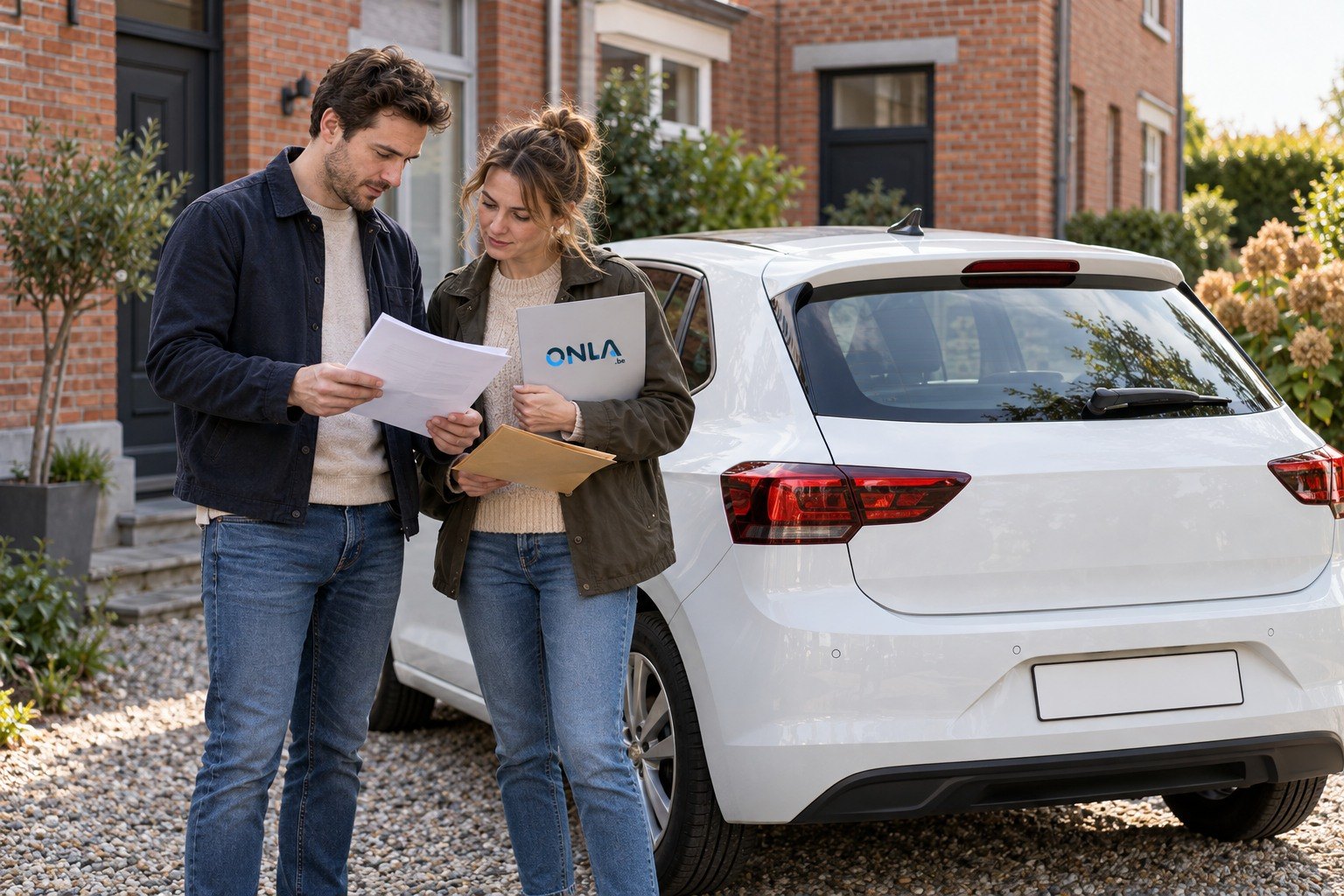
In Belgium, registering a car involves three related steps: insuring the vehicle, having the application processed by the DIV and budgeting for regional taxes. The price of the number plate therefore represents only a small part of the budget. The procedure also depends on the car: new, used and already registered in Belgium, or imported.
This guide mainly covers passenger cars intended for private use. Leasing, a business vehicle, a classic car, a temporary plate or an international situation may be subject to different rules. Information checked on 23 October 2026.
1. Who does what?
| Contact | Role |
|---|---|
| Seller | Supply the documents appropriate to the vehicle and sale |
| Insurer or broker | Arrange cover and submit eligible applications through WebDIV |
| DIV | Process the registration and issue the plate or certificate |
| bpost | Deliver the plate and/or certificate according to the procedure |
| Regional tax authority | Calculate and collect the applicable road taxes |
The DIV is the Vehicle Registration Directorate of the FPS Mobility and Transport. WebDIV is its application intended, in particular, for insurers and brokers to register their customers' vehicles. Source: FPS Mobility: how WebDIV works.
In a typical situation, start with your insurance intermediary. Going directly to a counter with incomplete paperwork may waste your time.
2. Prepare your budget before choosing the car
Compare the total cost: purchase, insurance, taxes, maintenance, fuel or charging and registration fees. For a used car, add anticipated repairs rather than spending all your savings on the advertised price.
You can browse the passenger car listings on OnLa, then request an insurance quote and check the taxes for the shortlisted vehicles. Use the data for the exact version: engine, energy source, power, CO2, age and other relevant tax characteristics.
A car offered in another region is not automatically subject to the taxes of the area where the garage is located. For your private purchase, check the rules that apply to your place of residence and circumstances.
3. Insurance: third-party motor insurance is essential
Motor third-party liability insurance, or RC Auto, is mandatory to register the car. It covers damage caused to victims when you are liable. On its own, it does not cover your injuries or damage to your own car when you are responsible for the accident.
Source: Wikifin: third-party motor insurance.
Which types of cover should you compare?
- Third-party motor insurance: mandatory liability cover.
- Mini-omnium or omnium: vehicle cover according to the policy, with exclusions and an excess to review.
- Driver insurance: cover for the driver's bodily injuries according to the policy terms.
- Assistance and legal expenses cover: additional services to consider according to your needs.
Ask for detailed terms rather than comparing only the monthly premium. Additional source: Wikifin: car insurance.
Declare the regular driver and intended use accurately. Have the date and time when the insurance takes effect confirmed, especially if you are replacing a car. The seller's insurance should not be treated as your cover after the purchase.
4. Documents: starting with the right paperwork
| Situation | Items to prepare |
|---|---|
| New car bought in Belgium | Registration application supplied by the seller, technical data and proof of purchase |
| Used car already registered in Belgium | Registration application, latest registration certificate or the police statement required in the event of loss, sale and inspection documents |
| Imported car | Original foreign documents, proof of purchase, import formalities and appropriate technical documents |
This list helps you organise the paperwork; it does not replace the documents required for your circumstances. The contract, Car-Pass and service records also help you check a used car before buying, even when they are not all documents to be submitted as part of the same DIV procedure.
For documents relating to a used-car sale: Belgium.be: sale procedure. For the Car-Pass: official buyer's guide.
Check the VIN, or chassis number, on the car and the documents. Have any discrepancy or missing document resolved before submitting the application.
5. The usual process: form, insurer, DIV
Complete and sign the application
Fill in the pink form with the registered holder's exact details. State whether you are requesting a new plate or wish to keep an available plate, select the correct vehicle situation and check the delivery address. Ask your insurer for help if in doubt.
Have the vehicle insured and registered
Send the necessary documents to your insurer or broker. For eligible cases, they submit the application through WebDIV. This professional service does not mean that buyers have access to a public WebDIV form to register all cars themselves.
If the electronic application is rejected, ask for proof of the rejection and the return of the documents, including the form bearing the insurance sticker. The complete file must then be submitted to the DIV by post or by appointment, according to the procedure.
Source: FPS Mobility: registering a car. Some transactions, such as a plate transfer or a duplicate, follow a different process: cases handled or not handled by WebDIV.
Ask for an application reference and keep copies of the relevant documents. Confirm what is missing with your intermediary rather than resubmitting several different applications.
6. Used cars: keep an eye on the form's validity period
For a used car, the FPS Mobility states that the registration application issued after the vehicle inspection is valid for two months. Check the date of the inspection centre's stamp, particularly in box X13. Do not leave the application pending until it expires.
Source: official procedure for a used car. If the form is too old or your circumstances are unusual, have the inspection centre and insurer confirm the procedure.
As of 14 October 2026, used-vehicle inspections are still required in the relevant cases in Flanders. Their abolition for vehicle sales within Belgium has been announced from 1 January 2027; imported vehicles remain subject to inspection. Source: Vlaanderen: used-vehicle inspection.
Vehicle inspection rules should not be confused with insurance, taxes or the Car-Pass. A change to one step does not automatically remove the other obligations.
7. A new number plate or keeping your number?
If you are replacing your car, have the possibility of keeping your European-format plate checked. Reusing the number does not remove the need to register the new vehicle or update the insurance. Also check the tax implications of this change.
In an ordinary sale, the seller's number plate is not simply handed over to the buyer. If you receive a notice of removal from the register, the DIV allows four months to cancel the plate or register another vehicle under the same European-format plate, subject to the applicable conditions.
If you need to cancel a number plate, only the DIV has carried out this operation since August 2025. bpost can forward your mailing, but no longer cancels plates at the counter. Source: FPS Mobility: cancelling and reusing a number plate.
8. Number plate price, delivery and certificate
The standard fees published by the FPS Mobility as of 14 October 2026 are as follows:
| Service | Fee |
|---|---|
| Number plate, possibly accompanied by the registration certificate | 30 € |
| Registration certificate only | 26 € |
| “Rush” delivery, when the conditions are met | Additional 80 € |
The 30 € and 26 € apply to two different situations; they are not automatically added together. Temporary or personalised plates have specific fees. The cost of a front plate reproduction should be considered separately.
Standard delivery times depend on when the application is sent to bpost: normally the next working day if it is sent before 18:00, or the second working day afterwards. This is not the time the DIV takes to process an entire application.
Check payment and receipt arrangements before delivery. Source: FPS Mobility: prices, delivery and tracking.
The two-part registration certificate
The CIM certifies registration; it is not proof of ownership. The two-part document includes one part to keep in the car and another to keep at home. Check the details as soon as you receive it.
Source: FPS Mobility: registration certificate. For a car requiring a front plate, have a compliant reproduction made and fitted; the official plate you receive is intended for the rear.
9. Taxes: distinguish registration tax from annual road tax
Vehicle registration tax is not the price of the number plate. It is separate from the annual road tax. A used car may incur a tax when registered by a new buyer, even if a previous owner has already paid their own tax.
| Region | Authority | Starting point |
|---|---|---|
| Brussels | Bruxelles Fiscalité | Rates and tax file through MyTax |
| Wallonia | SPW Finances | TMC calculation based on the registration date and vehicle |
| Flanders | Vlaamse Belastingdienst | BIV and annual road tax according to the applicable rules |
Exemptions, reductions and transfer situations require you to check the conditions. Do not apply the amount paid by a relative to your own case without comparing the details.
In Brussels
Bruxelles Fiscalité collects, among other taxes, vehicle registration tax and annual road tax; an additional tax applies to LPG. The amounts depend on the vehicle's characteristics and tax regime.
For an ordinary car, tax assessment notices are sent automatically based on DIV data; certain special vehicles require a declaration. Consult the official information from Bruxelles Fiscalité and the MyTax rates accessible from that page.
In Wallonia
For relevant car registrations from 1 July 2025 onwards, the TMC takes into account factors including power, CO2, maximum authorised mass and energy source, with a base amount reflecting the vehicle's age. Do not rely solely on engine capacity.
Use the official Walloon TMC simulator. It covers cars registered from 1 July 2025 onwards. Family reductions are available subject to conditions; check how they apply on the official TMC page.
For an ordinary car or hybrid, the SPW states that payment requests arrive automatically after registration. Source: SPW Finances: cars and hybrids.
In Flanders
BIV is the Flemish vehicle registration tax. Consult the Vlaamse Belastingdienst rules and the official simulator. The simulator page notes that it does not yet take a planned reform into account: check the rules applicable to your registration date. A simulation is only indicative.
For fully electric or hydrogen-powered vehicles, the rules distinguish between registrations before 2026 and those from 1 January 2026 onwards. For the relevant categories registered from that date, the flat-rate BIV is 61,50 € and an annual tax is payable, subject to indexation. Check the current annual amount and your particular circumstances, especially for a used car.
Source: Vlaanderen: taxation of electric and hydrogen-powered vehicles. Do not assume that an electric car is automatically exempt.
10. Importing: a separate set of paperwork
For a car coming from the European Union, the official procedure includes customs formalities through E705 or a customs branch, followed by preparation of the data and documents needed for registration. E705 does not constitute DIV registration.
Pre-registration of technical data is possible but is not mandatory for a private individual. If it is not done, the application must be processed by the DIV. For an imported vehicle that is not already registered in your name, the FPS requires a used-vehicle or administrative inspection, depending on the category.
Send the required documents to the insurer, including the foreign registration certificate. Also check compliance and the vehicle-specific conditions. Source: FPS Mobility: vehicle imported from the EU.
If you are moving with your own car, do not automatically follow the steps for buying from a foreign seller. For an import from outside the EU or particular residency circumstances, have the tax and technical formalities checked before paying for or transporting the vehicle.
11. Before taking to the road
- Insurance cover is in effect for the correct vehicle and use.
- Registration is confirmed and the necessary plates are fitted.
- The vehicle part of the CIM and the relevant documents are available.
- The applicable vehicle inspection requirements have been met.
- The vehicle and registered holder's details are correct.
- Access to low-emission zones has been checked if you will be driving in them.
Belgian registration does not automatically grant access to all LEZs. For Brussels, use the official LEZ website ; for Flemish zones, consult Vlaanderen: low-emission zones.
If the formalities are not complete, arrange a suitable handover or transport rather than assuming that the seller's documents or number plate are sufficient.
12. If there is a problem with the application or tax
For a rejected application, identify the reason with the insurer and check the VIN, documents and registered holder's details. For a delivery, use bpost's tracking service. For an error on the CIM, contact the DIV with the relevant supporting documents.
You can check the status of your vehicle or number plate through My vehicle, my plate. Keep the references and evidence of the steps you have taken.
If a tax notice seems incorrect, compare the characteristics and period with your records, then contact the regional authority according to the procedure and deadline stated. A request for clarification should not be treated as an automatic suspension of payment.
Checklist for preparing your registration
- Identify the process: new car, Belgian used car, import or replacement.
- Check the seller's documents and chassis numbers.
- Compare insurance and confirm when it takes effect.
- Estimate your region's TMC/BIV and annual road tax.
- Decide with the insurer whether a plate can be kept.
- Complete and sign the application with accurate contact details.
- Submit the application while the documents are still valid.
- Arrange delivery, check the CIM and fit the plates.
- Deal with the old number plate and insurance policy if necessary.
If you are still looking for your next car, browse the car listings on OnLa. Comparing models alongside their insurance, taxes and formalities helps you choose with a more realistic budget.
Discussion
Sign in on the main website to leave a comment.
No comments yet. Start the conversation.