

Scheduled publication: 20 November 2026. Information checked on 21 October 2026. Insurance cover and the rules applicable to your tenancy agreement must be checked against your circumstances.
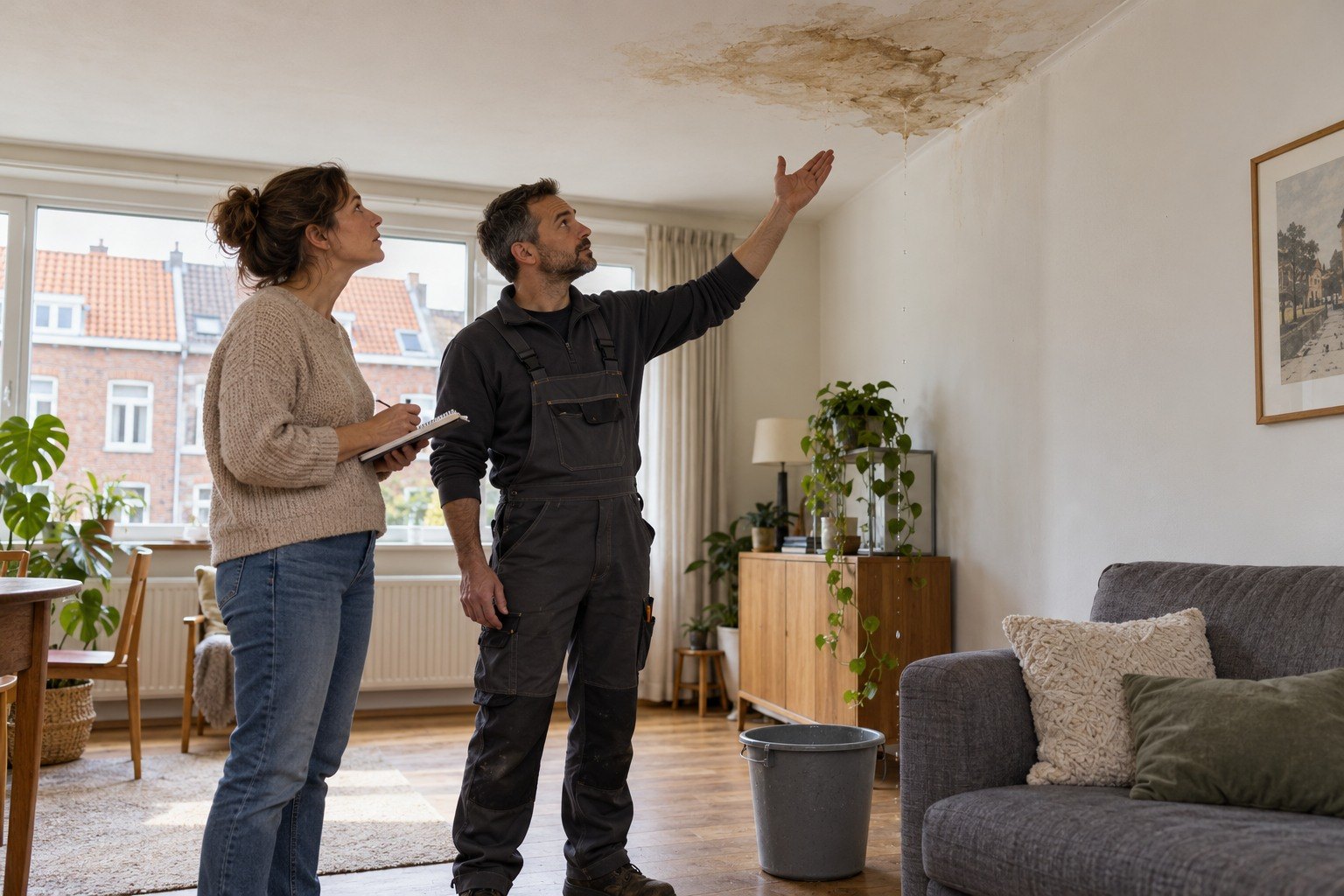
Water is coming through your ceiling, the downstairs neighbour discovers a water stain, or a pipe is leaking in a communal service shaft: who needs to act, and who will pay? In Belgium, the answer depends on the cause of the leak, the equipment involved, the occupants’ status and the insurance policies in place.
The upstairs neighbour is not automatically the person who has to pay for everything. A distinction must be made between repairing the cause, the damage caused by the water and additional costs. A single leak may require several types of work and involve several policies.
First priority: stop the water and keep people safe
Before discussing liability, try to limit the damage without taking risks. Turn off the water supply to the affected appliance or property if you can access it safely. Immediately notify the occupant of the apartment suspected of being the source, your landlord if you rent, and the property manager if the building is co-owned.
Move people and belongings away from the affected area. Do not touch a wet socket, light fitting or electrical panel. If water threatens the electrical installation or a ceiling appears unstable, keep your distance and call the appropriate professionals or emergency services. Call 112 in the event of immediate danger requiring emergency services ; a small tap leak is generally a matter for a plumber or your home assistance service.
Wikifin, an FSMA initiative, recommends turning off the water, protecting belongings and documenting the damage. Photograph the situation, but do not wait for a loss adjuster before stopping an active leak. Emergency measures and permanent repairs are two different stages.
Three questions to address separately
| Question | Examples | What to check |
|---|---|---|
| Who repairs the cause? | Punctured pipe, seal, connector or faulty appliance | Source, maintenance, age-related deterioration, private or communal status |
| Who compensates for the resulting damage? | Ceiling, paintwork, parquet flooring, furniture | Insured property, cover and liability |
| Who pays the additional costs? | Leak detection, drying, accommodation, excess | Terms, limits, supporting documents and possible recovery of costs |
The FPS Economy distinguishes water damage from repairs to the faulty installation. An insurance policy may cover resulting damage without paying to replace the part that caused the leak. Leak detection costs and the cost of opening up walls must also be assessed under the policy.
Ask for separate items on quotes and invoices: locating the leak, temporary work, pipe repair, closing up the wall, drying and finishing. This breakdown makes discussions easier when not all the expenses are payable by the same party.
Who is liable depending on the source of the leak?
The table provides guidance, but does not replace a diagnosis or an assessment of liability. Where the water appears is not enough to determine its source: it may travel through a floor slab or service shaft before becoming visible.
| Identified source | Liability to assess | Contacts to notify |
|---|---|---|
| Tap left running or overflow caused by use | Liability of the person who caused the overflow | Occupant, owner, relevant insurers |
| Insufficient maintenance of an item for which the tenant is responsible | Maintenance obligation and connection to the damage | Tenant, landlord, insurer |
| Ageing private pipework or a defect in the property | Owner’s obligations and liability arising from the defect | Owner, insurer, professional |
| Communal riser or installation | Management of the co-owned property and possible third-party liability | Property manager, co-owners’ association, building insurer |
| Leak following building work | Work carried out by the company, technical cause and applicable warranties | Client, contractor, insurers, property manager if necessary |
| Source still unknown | No firm conclusions before the findings are established | Insurer, owner and property manager to arrange leak detection |
A leak in the upstairs apartment may therefore involve its occupant, its owner, a communal installation or a company. A physical defect can also give rise to liability without an occupant having deliberately misused the equipment. Avoid reducing the assessment to “who was at fault?” or “whose apartment is the water visible in?”.
Tenant or owner: who pays for the repair?
In a rental property, routine maintenance and minor repairs must be distinguished from work required because of age-related deterioration, normal wear and tear or a building defect. The diagnosis must explain why the component leaked. Simply describing it as a “seal” or “pipe” is not always enough to decide.
A minor maintenance repair may be the tenant’s responsibility; replacing a worn-out pipe or carrying out a structural repair is generally the landlord’s responsibility. Damage caused by misuse may change this allocation. The tenant must also report problems: leaving a known leak unreported for a long time may lead to a dispute over the worsening of the damage.
To check the regional rules, consult:
- In Wallonia: the official list of repairs, work and maintenance, which distinguishes the landlord’s obligations from the tenant’s.
- In Brussels: the regional allocation of repair responsibilities, including exceptions relating to age-related deterioration and force majeure.
- In Flanders: the official rules on maintenance and repairs, to be reviewed with particular attention to the date of the tenancy agreement.
This division of responsibilities between landlord and tenant does not, on its own, settle compensation for the neighbour. Liability towards a third party and insurance cover require a separate assessment.
In a co-owned building: what is the property manager’s role?
Notify the property manager promptly if a service shaft, roof, riser or several apartments are affected. Ask them to help establish whether the installation is private or communal and coordinate the process with the building insurer. Do not assume a pipe is private simply because it runs through your apartment.
A comprehensive policy, often called “block insurance”, may cover communal and private parts of the building. However, it does not necessarily cover your furniture and personal belongings. Wikifin explains how this collective insurance works and the importance of checking the insured amounts and property.
Ask for the claim number, the name of the claims handler and details of the relevant cover. If any costs remain payable by the co-owners’ association, their allocation must be assessed under the applicable rules and any liability involved. The property manager is a management contact; they are not automatically personally liable for the incident.
Which insurer should you contact if you are the affected party?
Report the claim to your own home insurer without waiting for your neighbour to acknowledge liability. If you are a tenant, also notify your landlord about damage to the building. In a co-owned building, inform the building manager if the building-wide policy may be involved.
Your insurer can assess compensation under your cover, followed by any potential recovery action. This depends on what is covered; it does not guarantee reimbursement of every expense. AG recommends contacting your own insurer even when the leak comes from your neighbour’s home.
Buildings insurance and contents insurance do not cover the same property. Identify who owns the damaged flooring, kitchen, furniture or fittings. Avoid assuming that a claim reported by another occupant already includes all your personal losses.
If the leak comes from your home
Stop using the equipment concerned, notify the affected neighbours and report the facts to your insurer. If you rent, inform your landlord. State what you know and what remains uncertain: “a leak observed at the washing machine connection” is more precise than “I am responsible for everything”.
Cooperate with inspections and arrange the necessary access with those involved. Cover for your liability towards your neighbour depends in particular on the cause and the cover you have taken out. Do not assume, without checking, that family liability insurance is a substitute for your home insurance.
If your landlord has a waiver of recourse clause, have its scope checked. It does not automatically insure your belongings or all damage to neighbours. Vlaanderen.be explains the possible limitations of this clause. Do not settle for verbal confirmation that “the whole building is insured”.
What can insurance cover, and what can it refuse to cover?
Check the general and specific policy terms: covered events, insured property, exclusions, excess and limits. “Water damage” cover may apply to a damaged ceiling or furniture, with different conditions for leak detection, repairing the cause and incidental expenses.
Wikifin points out that repairing a faulty pipe is not always covered. A refusal to cover this repair therefore does not necessarily mean that the resulting damage is also excluded. Ask for a separate response for each item and the clause relied upon.
Ask these questions before incurring major expenses:
- Does leak detection require prior authorisation?
- Does the policy cover opening up surfaces and making them good?
- Are drying, dehumidifiers or accommodation covered?
- Does a professional need to be appointed by the insurer?
- What supporting documents and limits apply to these costs?
Excess, upfront payments and out-of-pocket costs
The excess is the portion specified in the policy that is not included in the compensation. Its amount is not the same for every insurance policy. Depending on the liability established and the available recovery options, you may seek to recover certain costs from the responsible party. Reimbursement is not automatic simply because the water appears to come from their home.
The person who orders emergency repairs may be asked to pay the company before the claim is settled. Clarify who is placing the order, who will receive the invoice and what the assistance service agrees to cover. Keep supporting documents and request written confirmation where possible, without delaying an essential measure to stop the damage.
If no one is insured, the absence of insurance does not remove any potential liability. However, it makes recovering the money less certain. Have the evidence and options for recovery assessed rather than assuming that the co-ownership association or the other occupant will necessarily pay for everything.
What documentation should you prepare, and do you need a joint report?
Keep a timeline: discovery, calls, shutting off the water, work carried out and changes in visible signs of damage. Gather wide-angle and close-up photos, correspondence, the plumber’s report, quotes and invoices. Ask the professional to distinguish an established cause from a mere hypothesis.
Also draw up a list of the affected belongings, including their age, value and any available supporting documents. The claims management steps outlined by Ethias specifically recommend documenting the damage and keeping damaged belongings, where possible, for a potential expert assessment. Do not keep a dangerous item solely as evidence: ask how to document it.
A joint report with the parties concerned helps bring the facts together. Use the document requested by your insurer or a clear account stating the homes involved, occupants, date, damage and known or suspected source. If the cause is unknown, say so. Do not sign a general admission of liability to obtain help more quickly.
Report the claim as soon as possible and check the deadline in your policy. Do not automatically apply a deadline found in a foreign guide. A disagreement between neighbours should not prevent you from reporting your own claim.
When should permanent repairs begin?
Have the leak stopped and protect the premises immediately. For permanent repairs, coordinate with the owner, building manager and insurer to preserve useful evidence. Ask how to check that surfaces have dried before repainting or closing up a wall. Covering a water stain does not prove that the cause has been resolved.
If you are looking for a professional for leak detection or restoration, you can browse the listings available on OnLa.be, then check references and request a detailed quote. Before placing an order, ask your insurer whether it provides assistance or requires a specific procedure. The presence of a listing does not guarantee reimbursement for the work.
The neighbour, landlord or insurer is not responding: what should you do?
Send a written request describing the facts, the steps already taken and the action expected. Set a deadline appropriate to the urgency, without presenting it as a universal legal deadline. If water is actively leaking and poses a danger, contact the appropriate services; do not force your way into the neighbouring home.
Example to adapt: “Since [date], water ingress has been affecting the ceiling in [room]. The source has yet to be confirmed. Please find the photos and the contact details of the professional who attended. Please confirm promptly the arrangements for investigating the source and taking the necessary measures, as well as the insurance claim reference.”
For a dispute with the insurer, ask for the reasons for its position in writing, then contact its complaints department. If the disagreement persists, you can contact theInsurance Ombudsman : among other things, it asks for a description of the problem, the company concerned and the claim reference. This service is not a substitute for urgent action to stop the leak.
For disputes between tenants and landlords or between neighbours, have the options for mediation and legal action before the competent court assessed. A joint expert assessment may be useful if the source is disputed; find out about its scope and costs beforehand. Wikifin explains the steps involved in an expert assessment and disputing a compensation payment.
If the home becomes unusable, document the rooms affected and seek advice on accommodation, repairs and the implications for the tenancy. Do not simply deduct all your expenses from the rent: have your rights and the appropriate procedure clarified.
Key steps to remember
- Protect people and stop the water safely.
- Notify the neighbour, landlord, building manager and insurer as appropriate.
- Document the damage and have the cause identified.
- Distinguish between repairing the leak, damage and incidental expenses.
- Have cover confirmed before incurring major expenses.
- Arrange restoration after the necessary inspections and drying.



Discussion
Sign in on the main website to leave a comment.
No comments yet. Start the conversation.