

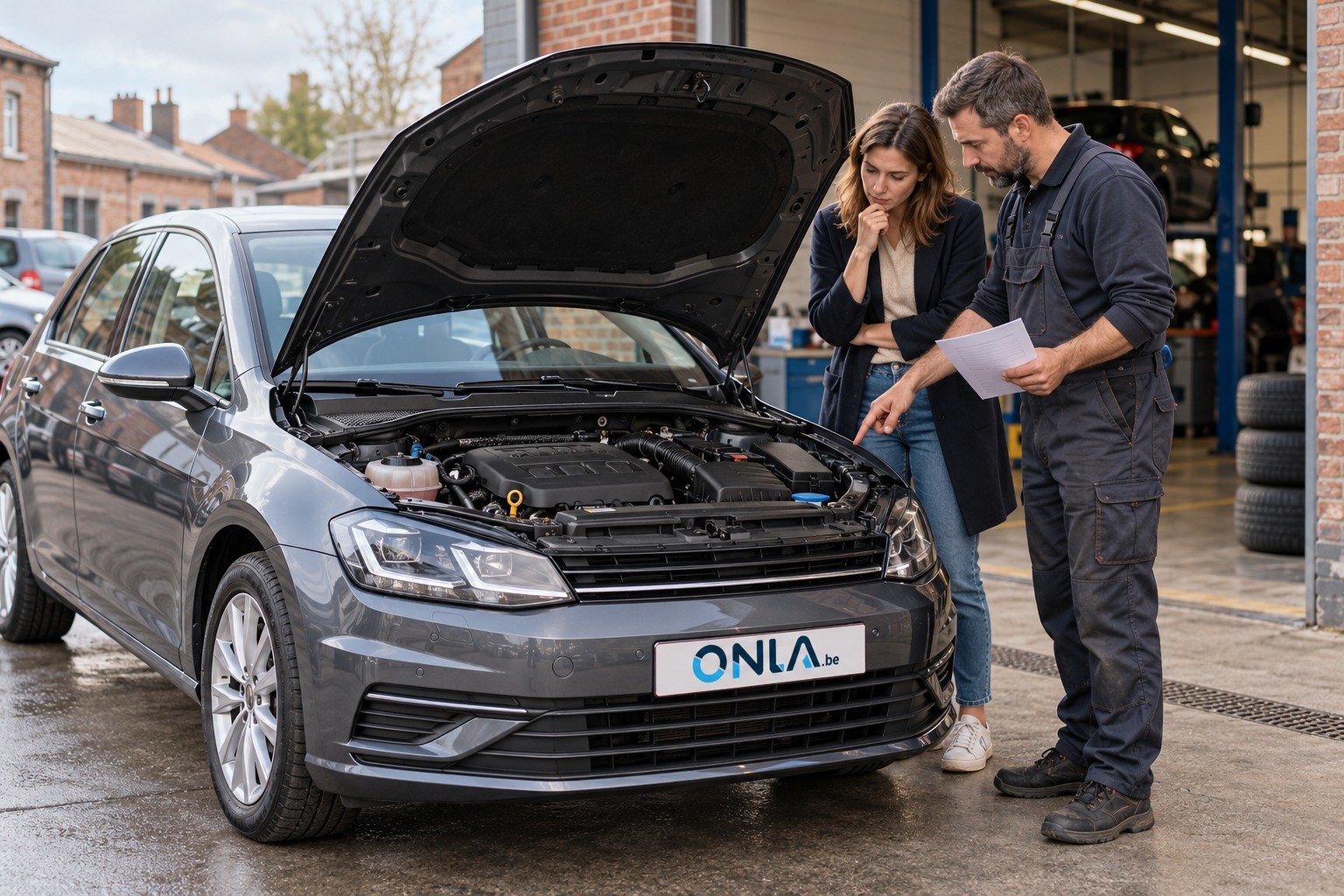
A used car may look immaculate in photos yet leave you facing significant expenses after purchase. The right approach is not to look for a brand that “never breaks down”, but to check the specific vehicle: its identity, documents, maintenance, condition and terms of sale.
Here are 15 essential checks before buying a used car in Belgium. Prepare them before the appointment, take time for a test drive and have the vehicle examined by an independent professional if anything remains uncertain. This checklist helps identify risks; it does not replace a mechanical diagnosis.
Information verified on 30 October 2026. These procedures mainly concern private individuals buying a car already registered in Belgium. Imports, business purchases or particular circumstances require additional checks.
1. Identify the seller and their actual status
Ask who is legally selling you the car: a private individual, a garage or another professional. The name on the contract and the recipient of the payment must be clearly explained. For a business, check its identity and contact details; for a sale on behalf of a third party, ask on what authority the person is acting.
Meeting at a garage does not in itself identify the party you are contracting with. If you are ultimately presented with a contract between private individuals, ask for an explanation before signing: the seller’s status affects the protections that apply.
Do not treat the registration certificate as proof of ownership. FPS Mobility expressly states this limitation. A different name does not automatically establish fraud, but it must be clarified.
2. Compare the chassis number and documents
The VIN, or chassis number, identifies the car. Compare the one on the vehicle with those on the documents: registration certificate, certificate of conformity, Car-Pass and contract. Seek advice if any marking appears altered or the details do not match.
For a standard sale in Belgium, prepare this document checklist:
- Registration certificate, including both parts where it was issued in that format.
- Certificate of conformity and documents relating to special equipment, such as an LPG installation.
- The applicable roadworthiness inspection documents and registration application form.
- A recent Car-Pass, contract or invoice, and maintenance records.
The official Belgium.be checklist helps you prepare for the handover. If the registration certificate has been lost, FPS Mobility provides for a police certificate: a simple promise to find the papers is not enough to prepare your application.
If the vehicle comes from abroad, check the original documents and formalities before paying a deposit. Consult Car-Pass advice on imported cars and the FPS Mobility procedure for importing from the EU.
3. Check the Car-Pass and mileage consistency
For a used-car sale to a private buyer covered by this requirement, the seller must provide a valid Car-Pass, whether they are a private individual or a professional. The document must be no more than two months old. The exception for a professional buyer in the motor trade must not be applied to your private purchase.
Check its authenticity through the official Car-Pass service, using the document number or its QR code. Compare the information displayed, the VIN and the odometer reading. Also examine how the recorded mileages progress and any periods with few records.
An authentic Car-Pass does not, on its own, certify that a car has never been in an accident or guarantee the engine’s future reliability. For an imported car, the history before its arrival in Belgium may be incomplete. The official buyer’s guide explains the available data and these limitations. Do not finalise a purchase based solely on “I’ll send it to you later”.
4. Read the roadworthiness certificate and used-car report, and check their dates
Do not look only at the certificate’s colour. Read the defects, comments, restrictions and any requirements for a reinspection. Ask what repairs have been carried out and keep the supporting documents.
The FPS Mobility states that the registration application form issued after the inspection is valid for two months. Check the date in box X13. Do not confuse this period with the validity of the roadworthiness certificate or the age of the Car-Pass: these are separate documents.
The roadworthiness inspection does not replace a pre-purchase inspection covering all mechanical risks and upcoming costs. A vehicle that passes the inspection may still need maintenance or have a problem requiring a thorough diagnosis.
Be aware of future rules: Flanders has announced that mandatory used-car inspections for the domestic sales concerned will be abolished from 1 January 2027, while remaining mandatory for imported vehicles. This announced reform must not be applied in advance to a purchase in October 2026, nor automatically extended to the other regions. Consult the updated Flemish page before buying.
5. Reconstruct the maintenance history and major repairs
Ask for invoices and the service history, either on paper or in a verifiable digital format. Check the dates, mileages, work carried out and vehicle details. A stamped service book without details warrants further questions.
Identify the exact engine version and ask about the manufacturer’s prescribed intervals: timing belt or chain maintenance depending on the engine, gearbox servicing where required, fluids, filters and specific procedures. A generic rule found for another engine from the same brand is not enough.
The Car-Pass also contains information on work reported by professionals. Consult the explanation of the data shown on the document. Cross-check them against the invoices and ask what is due next. The aim is to establish your upcoming budget, not simply to confirm that maintenance was carried out at some point.
6. Check for safety recalls
Look for outstanding recalls on the Car-Pass and contact the brand’s dealer network with the VIN. Ask whether the work has been completed and what documentation confirms it.
Car-Pass states that outstanding recalls may appear with a manufacturer’s code and a short description. The data comes from the manufacturer and is not presented as exhaustive. Consult the official recall information sheet.
If a recall concerns safety, ask for the applicable instructions before the test drive or use. An oral promise of a later repair should be replaced with a specific commitment and confirmation that the work has been completed.
7. Confirm suitability for your journeys and LEZs
Check the fuel type, Euro standard, vehicle category and the cities where you need to drive. The year of first registration is not a substitute for all this information. A bargain becomes less attractive if it does not suit your usual journeys.
In Brussels, since 1 January 2026, Euro 5 diesel and Euro 2 petrol cars no longer meet the standard LEZ access criteria. Passes or exemptions are available subject to conditions. Use the information and tools on LEZ.brussels for the specific vehicle, and do not confuse a warning scheme with permanent permission to enter.
The rules in Brussels, Antwerp and Ghent are not identical. The official Flemish LEZ page links to local checks. Also check published changes covering your intended period of use: current access is not a guarantee for all the years ahead.
8. Examine the bodywork, glass and signs of repair
Inspect the car when it is clean, in daylight and from several angles. Look for differences in paint colour, misaligned panels, corrosion, cracked glass or unusual seals. Open the doors and boot; inspect accessible areas without crawling under a vehicle that has not been safely secured.
A bodywork repair is not automatically a reason to reject a car. Ask what was damaged, who carried out the work and what documentation exists. However, a discrepancy between the condition you observe and a claim that the car has “never been in an accident” calls for an expert inspection.
The RAC mechanical checklist, in English covers panel alignment, corrosion and glass, among other things. Only its technical points are relevant here; British formalities are not the same as Belgian procedures.
9. Inspect the tyres, brakes and signs of wear
Examine all four tyres for wear, cuts, bulges and significant differences between the sides. Check the wear indicators and, if possible, measure tread depth in several places. Uneven wear warrants a check; it does not, on its own, identify a fault.
Also check the dimensions and specifications required for the vehicle. Michelin explains how to check the wear indicators and the different areas of a tyre. Do not settle for a tyre that still looks good in a photo.
Ask for a professional brake inspection if their condition remains uncertain. During the test drive, abnormal braking or vibrations should be investigated before purchase. Get a quote for any necessary replacements: negotiating a few hundred euros off without knowing the actual cost of the work is not an assessment.
10. Observe a cold start and inspect the engine bay
Ask whether you can see the car before its first start of the day. Observe how easily it starts, its idle, noises, persistent smoke and warning lights. A symptom is not a diagnosis: have it identified rather than accepting a vague explanation.
Check accessible fluid levels according to the manual and look for signs of leaks. Never open a hot cooling system or put your hands near moving parts. A cleaned engine compartment proves neither fraud nor the absence of leaks.
The RAC guide to inspecting a used car recommends, among other things, observing a cold start and then a restart after the engine has been running. If the vehicle is already warm, simply note that this check has not been carried out and ask how it can be completed.
11. Check the gearbox, clutch, steering and suspension
Test the transmission under normal conditions. With a manual gearbox, observe gear changes and clutch behaviour. With an automatic, try manoeuvres and gear changes without pushing the vehicle.
Jerking, slipping, noises or irregular behaviour require diagnosis. The steering and suspension deserve the same attention: do not settle for a price reduction if you do not know the cause.
The RAC technical preparation standard distinguishes these components, braking and abnormal noises. Ask the independent specialist for checks appropriate to this transmission and model, rather than a simple opinion that “it drives well”.
12. Test the interior, equipment and warning lights
Try the windows, locks, mirrors, lights, wipers, heating and air conditioning. Check the seat belts and seat adjustments. Test the optional equipment actually included in the price and ask how many working keys will be handed over.
Observe the warning lights when switching on the ignition, then after starting, following the manual. A safety warning light that stays on, or an unusual self-test sequence, warrants a check. Do not assume that the absence of warnings rules out all faults.
Note any untested equipment and declared faults so they can be included in the contract. Checks on controls, lights and seat belts also feature in the RAC technical checklist.
13. Take a proper test drive
Agree on a route that allows you, where possible, to check manoeuvres, city driving and driving at higher speeds. Before setting off, make sure that insurance cover and road-use requirements allow the test drive with you at the wheel. Do not assume that your personal insurance automatically covers any car.
Drive normally, without dangerous testing: listen, observe how the car holds its course, brakes and accelerates. On returning, check for any new warnings and have any suspected leaks inspected. The RAC checklist includes checks while driving and observations after the drive.
If a test drive is refused, ask for a reason and a credible alternative, such as an independent inspection. Do not automatically mark a check as passed when it could not be carried out. A viewing cut short by rain or lack of time can simply be rescheduled.
14. Tailor the checks to the powertrain and calculate the total cost
For an electric car or plug-in hybrid, ask for a recent report on the traction battery's state of health, or SOH, including its method and date. A range displayed on the dashboard is not a certificate of capacity. Check charging, the cables supplied and the terms of the remaining battery warranty.
TheADAC recommends documenting the battery's condition before purchase. The SOH may appear on the Car-Pass when it has been provided: this information remains optional, as Car-Pass states. Its absence should not automatically be presented as an infringement.
For a combustion-engine car, have the points specific to the exact engine and its emissions control system checked. For all cars, prepare this budget before finalising the purchase:
| Expense | How to check it |
|---|---|
| Purchase and any delivery charges | Written total price and breakdown of charges. |
| Vehicle registration tax and annual tax | Calculation using the vehicle's details and your region's rules. |
| Insurance | A quote matching your profile, usage and desired cover. |
| Upcoming maintenance and repairs | Manufacturer's maintenance schedule, inspection and quotes. |
| Fuel or charging | Your journeys, charging options and actual rates. |
| Financing, if applicable | Total cost, interest rate, term and conditions; not just the monthly payment. |
For taxes, consult the Walloon vehicle registration tax calculator or the Vlaamse Belastingdienst tools, depending on your situation. In Brussels, check the Brussels Taxation rates. An estimate is indicative; do not assume that the amount paid by the previous owner will be the amount you pay.
15. Review the contract, warranty and payment terms
The contract must identify the parties and the car, its VIN, mileage, price, declared defects, included equipment and delivery arrangements. Have any promised repairs, the party responsible and the deadline specified. Keep a signed copy, the listing and relevant correspondence.
When a professional seller sells to a consumer for private use: the statutory guarantee of conformity is generally two years. For used goods, a contractual reduction is possible, with clear and unambiguous information, but never to less than one year. Without a valid reduction, the two-year period applies. Consult the guarantee law explained by FPS Economy.
Do not confuse this protection with a commercial warranty limited to a few components. Normal wear and tear is assessed on a case-by-case basis; it does not allow all so-called wear parts to be excluded in advance. ConsumerConnect explains professional sellers' obligations. This statutory consumer guarantee scheme does not apply to sales between private individuals; any other possible remedies must be assessed based on the facts and the contract.
Agree on a traceable payment method and verify the recipient. If a deposit is requested, set out its purpose and the agreed conditions in writing before paying. Reject links that require your banking codes to “secure” the transaction. Finally, arrange insurance and registration before using the vehicle; do not assume you can drive away with the seller's number plate.
When should you postpone the purchase or request an expert inspection?
Postpone the decision if an essential document is missing, if the VIN does not match, if the history remains contradictory or if a safety defect is unexplained. A price reduction does not resolve an inability to register the vehicle or a mechanical uncertainty with no cost estimate.
You can request an independent report specifying the points checked, the limitations of the inspection, urgent work and expected expenses. No reputable professional can promise that a used car will never break down.
Compare listings using a simple method
Keep a record for each car: seller, VIN, powertrain, mileage, documented maintenance, work required, documents received and estimated total price. Compare similar versions, rather than two listings that merely share the same model name.
You can start with the passenger car listings on OnLa, then ask the seller for the items on this list before travelling to view the car. The listing facilitates initial contact; the checks and terms of sale must be confirmed for each vehicle.
Practical message to send: “Hello, before the viewing, could you confirm the exact powertrain, the documents available, the date of the Car-Pass, the maintenance history and any repairs needed? I would also like to arrange a test drive and, if necessary, an independent inspection.”


Discussion
Sign in on the main website to leave a comment.
No comments yet. Start the conversation.