

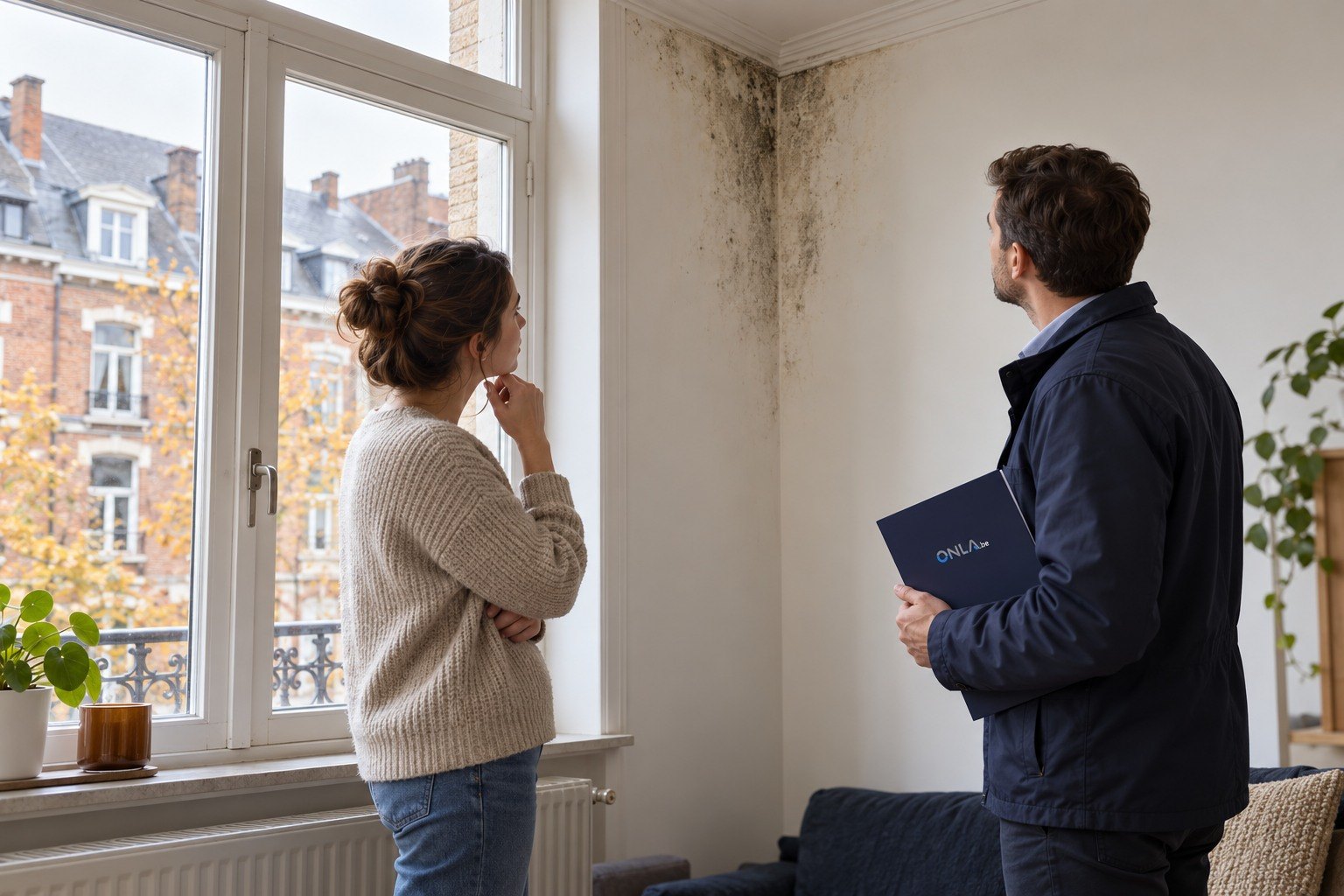
Stains appear around the windows, a wall stays damp or a musty smell returns despite cleaning. The landlord blames a lack of airing; the tenant suspects a leak or a building defect. Who should pay for the assessment, repairs and damage?
The answer depends on the cause and the responsibilities established. Water ingress, faulty ventilation and a lack of maintenance are not dealt with in the same way. Several causes may also combine. Before allocating costs, it is therefore necessary to understand the problem and preserve evidence.
Publication date: 31 October 2026. Legal information and sources checked on 19 October 2026. This guide mainly concerns private residential rentals in Belgium; the region, type of lease and its date may affect the applicable rules.
1. Who should pay? The basic rule
The landlord must provide and maintain a property that meets the applicable requirements and pay for repairs that fall under their responsibility. The tenant must use the property properly, carry out the maintenance and tenant repairs for which they are responsible, and report problems requiring action.
In Brussels, the official allocation of repair responsibilities distinguishes tenant maintenance from other necessary repairs, while taking account of ageing and any wrongful conduct by the occupant. In Flanders, the official maintenance and repair rules also set out obligations for each party.
The presence of mould therefore does not automatically prove that either the tenant or the owner is at fault. A general clause in the lease does not replace an analysis of the cause and the applicable mandatory rules.
2. Identify the cause before discussing the bill
Homegrade distinguishes between, among other things, water ingress, rising damp from the ground, leaks, condensation and residual moisture after building work. Different causes can produce similar symptoms. A photograph or the colour of a stain alone is not enough to reach a conclusion.
Condensation forms when water vapour meets a sufficiently cold surface. It therefore depends on indoor humidity as well as wall surface temperatures and air renewal. See Homegrade's explanations of the causes of damp.
| Situation to examine | Key question | Possible responsibility, to be confirmed |
|---|---|---|
| Water ingress through the roof, façade or a joint. | Building defect, ageing, relevant maintenance or damage caused by someone? | Building repairs may be the landlord's responsibility; the exact cause must be established. |
| Leaking pipe. | Where is the leak and why did it occur? | The owner, occupant or a third party, depending on the cause and the applicable obligations. |
| Condensation on a cold wall. | Condition of the walls, available ventilation and actual use? | No automatic allocation of responsibility: examine both the property and how it is used. |
| Deliberately blocked vent or poorly maintained equipment. | Did this behaviour cause or worsen the problems? | The tenant may be held liable if the link is established. |
| Defect following renovation. | Planned ventilation, drying and execution of the work? | Examine the project and the work carried out rather than concluding that it is simply a lack of airing. |
This table helps prepare for the discussion; it does not determine liability. The specific obligations must be checked against the regional list and, if in doubt, technical advice should be sought.
3. When repairs may be the owner's responsibility
A leak caused by an ageing pipe, a defective roof or broken ventilation equipment may require work at the landlord's expense. However, the repair itself must be distinguished from routine maintenance or damage attributable to the occupant.
In Wallonia, Articles 7 to 10 of the Residential Tenancy Decree govern, among other things, the condition of the property, repairs and defects affecting its use. The regional brochure on housing quality covers damp and ventilation among the housing health standards.
Simply advising the tenant to open the windows more often is not necessarily an adequate response by the landlord to water ingress. Conversely, a cold wall alone is not enough to require a specific insulation method: an assessment must determine the necessary work and the applicable requirements.
If the problem appears to originate in a communal area or a neighbouring property, inform your landlord. The building manager, another owner or an insurer may need to intervene. Ask who is coordinating the investigation into the cause and the repairs, rather than assuming that mentioning “co-ownership” resolves the situation on its own.
4. When the tenant may have to pay
The tenant may be responsible for a lack of maintenance, improper use or damage they have caused. Failure to report a problem can also make it worse: allowing a known leak to continue without notifying the landlord can complicate the allocation of responsibility for additional damage.
The Flemish page on obligations during the tenancy distinguishes, among other things, between misuse, poor maintenance and failure to notify.
Nevertheless, what is being alleged and its role in the damage must be established. A low heating bill, laundry dried indoors on one occasion or droplets on a window are not enough, on their own, to explain an entire mould problem.
In practice, ask: “What behaviour is alleged to have caused which damage, and what findings are you relying on?” If several factors are established, an allocation of costs can be discussed. There is no automatic 50/50 split simply because the parties disagree.
5. Obtain a useful, independent assessment
If the cause remains disputed, suggest a joint inspection and, if necessary, an expert chosen by mutual agreement. The SPW discusses this approach in its advice on maintenance and repairs during a tenancy.
Before commissioning an assessment, agree in writing on its scope, price and who will pay the costs upfront. A provisional sharing of the assessment cost does not automatically determine who will ultimately pay for the work or damage.
Ask for a report specifying:
- The areas examined, dates and measurements taken.
- The identified causes, the evidence supporting them and any uncertainties.
- The condition and operation of the ventilation.
- Urgent measures and any further investigations needed.
- The proposed work and the conditions for drying and making good.
The Homegrade technical brochure helps you prepare your questions. A commercial quotation that immediately proposes a treatment does not necessarily answer every question about cause and responsibility.
6. Gather evidence as soon as the problem appears
Take dated photographs, including an overview and close-ups. Note the affected rooms, how the problem develops, any smells and the circumstances: rain, a visible leak, an extractor failure or recent work. Keep correspondence with the landlord and anyone who has attended.
Also gather the lease, the check-in inventory, previous reports of problems, maintenance invoices and any available reports. If personal belongings are affected, photograph them and keep any proof of purchase or value you have.
A hygrometer can help monitor changes in indoor air humidity. Record readings at different times, along with the temperature and occupancy conditions. A single reading proves neither the source of damp in a wall nor that either party is at fault.
Preserve this evidence before any work is carried out, without delaying urgent safety measures. A simple filing system is enough: a timeline, a folder of photographs and a list of actions taken and expenses incurred.
7. Notify the landlord in writing
Describe the facts without presenting a hypothesis as a confirmed diagnosis. Request a visit, an investigation into the cause and a timetable for action. Suggest times when you are available and facilitate agreed access for the necessary investigations and work.
If there is no response or the landlord refuses, a formal notice sent by registered post, with a copy by email, allows you to formalise your request and retain proof of sending. The Walloon investigation request form specifically requires, unless an indicated exception applies, a copy of the registered letter sent to the owner and proof of posting.
Message template to adapt
Subject: damp and mould — request for action at the property [address]
Dear Sir or Madam,
Since [date], I have noticed [description] in [rooms]. The problem has developed as follows: [facts]. Please find attached photographs and the available information.
I ask you to arrange a visit to identify the cause and agree on the necessary measures. I am available [time slots]. Please confirm in writing the proposed next steps and schedule within seven days of receiving this letter.
At this stage, the cause of the problem remains to be determined. I reserve my rights regarding repairs and damage. In the absence of an appropriate response, I will contact the relevant services and, if necessary, the justice of the peace.
[Name, contact details, date and signature]
The seven-day period is a suggested response time for this template, not a universal legal deadline for repairs. An active leak or a hazard requires a faster response. If you have already obtained a report, adapt the letter to its findings rather than stating that the cause is unknown.
8. Who pays the various costs upfront, and who ultimately bears them?
Avoid discussing a single overall amount. Ask for the costs and commitments to be broken down:
| Cost item | What to clarify before paying |
|---|---|
| Diagnosis or leak detection | Who commissions the work, what is its scope, who pays upfront and how will the allocation of costs be assessed? |
| Repairing the cause | What cause has been established, and who is responsible for the work? |
| Drying and remediation | What treatment is needed, for how long and with what follow-up? |
| Paint, plaster or coverings | When will the underlying surface allow lasting repairs? |
| Furniture, clothing and other belongings | What evidence is there of the damage, the value of the items and the link to the problem? |
| Utility costs or temporary accommodation | What expenses, what supporting evidence, and what agreement or basis for requesting reimbursement? |
The person who pays an invoice upfront is not necessarily the one who must ultimately bear the cost. However, hiring a contractor without agreement can create a new dispute. Before incurring a significant expense, have the arrangements clarified in writing; in an emergency, promptly seek advice on the appropriate steps and keep all supporting documents.
If water damage may be covered by insurance, notify your insurer in accordance with your policy and inform the landlord. Ask which costs are covered, what documents are needed and what measures should be taken to prevent further damage. Insurance does not automatically cover all costs related to condensation, a long-standing defect or mould. The policy and the cause of the damage must be examined.
9. Where can you request an inspection in each region?
Brussels: Brussels Housing and the DIRL
A rented property must meet the applicable safety, health and equipment requirements. You can submit a complaint about non-compliance with Brussels Housing. The page sets out the conditions and procedure.
This process may lead to an order to carry out work, but also to a ban on renting out the property where the situation warrants it. It may therefore affect occupancy. If you need to leave, ask about the social support available; immediate rehousing or compensation is not automatically guaranteed.
Wallonia: the relevant municipality or the SPW's Housing Health Service
The request for an inspection must be sent to the municipality where it has this authority. Otherwise, it falls under the SPW's Housing Health Service. Consult the official procedure and the documents to attach.
The report examines housing health criteria and enables the authorities to take appropriate action. An administrative inspection does not automatically allocate responsibility for each invoice or item of damage between the parties. For a property in one of the municipalities of the German-speaking Community, check locally which authority is responsible before submitting the request.
Flanders: start with the municipality
If the landlord does not remedy the defects, report the problem to the municipal housing service. Simply reporting it may lead to a warning procedure; it does not automatically trigger a declaration that the property is unfit or uninhabitable.
A formal request is subject to specific conditions. The official Flemish page on reporting problems explains the steps and their consequences. Ask for an acknowledgement of receipt and information relevant to your situation.
10. Can the justice of the peace order repairs or reduce the rent?
A tenancy dispute can be brought before the justice of the peace. You can seek an agreement through conciliation: this procedure is free. If the parties agree, an official record can make the agreement enforceable. If they do not agree, conciliation does not itself resolve the dispute.
See the official guidance on conciliation. Court proceedings can then be used to seek a ruling; they involve costs and require preparation.
Depending on the rules and the facts, claims may include carrying out repairs, an expert assessment, a rent reduction, termination of the lease or damages. In Wallonia, Article 9 of the decree provides, subject to conditions, for remedies where a landlord who has first been formally notified fails to bring the property into compliance, as well as a rent reduction that the judge may grant pending the work.
Avoid withholding rent, deducting invoices or treating the lease as terminated on your own initiative. These decisions can lead to a dispute over arrears or termination of the contract. Have the appropriate course of action and any exceptions checked before acting; formalise any agreement on reduced rent.
11. Limit the problem without masking the cause
Use the ventilation systems provided and do not block air inlets or outlets. Report any extractor malfunction, limit the build-up of steam and adapt heating and airing to the property. A dehumidifier can support remedial work, but does not in itself establish that the cause has been resolved.
Homegrade points out that ventilation must also be considered after renovations that make a home more airtight. Painting over a surface that is still damp or replacing only the finish is no substitute for addressing the underlying cause.
For cleaning, ask for a method suited to the surface, the extent of the problem and the occupants. Extensive or recurring contamination requires professional advice. FPS Public Health recommends also addressing the cause, following the label instructions, ventilating and never mixing different products. Do not use more and more products to try to compensate for a building defect.
12. Health: do not wait for the dispute to be resolved before seeking advice
Mould in a damp or poorly ventilated home can cause or sustain certain allergic or respiratory symptoms. The Sciensano's AirAllergy network highlights links with rhinitis, conjunctivitis and asthma, among other conditions.
If you have symptoms or concerns about a vulnerable person, consult a healthcare professional and describe the environment. A photograph cannot diagnose an illness or establish how dangerous mould is based on its colour.
Medical follow-up and a building diagnosis are complementary: a medical document does not, on its own, determine the legal responsibility of the landlord or tenant.
Preparing for the next stage of your tenancy
Keep a summary of the steps taken, commitments made and work carried out. After the work, document any changes and ask how to check that the problem does not return. If deductions from the tenancy deposit are announced when you leave, ask for a breakdown and the evidence establishing your responsibility.
If you are looking for another home, you can browse the rental listings on OnLa. During viewings, ask the advertiser about ventilation, previous damp problems and work carried out. The energy performance certificate and a fresh coat of paint are no substitute for these checks.
Frequently asked questions
Does “It is condensation” mean I have to pay?
No. You need to examine why it forms and the respective roles of the building, its equipment and how they are used.
Does the landlord have to pay for all my damaged furniture?
Reimbursement is not automatic. Document the damage, the value of the items and their link to the cause for which responsibility is disputed. Also check the relevant insurance policies.
Who pays the expert?
Agree on the scope of the assessment and the upfront payment before commissioning it. The final allocation of costs may be determined by agreement or a court ruling; it does not automatically depend on who requested the visit.
Does an inspection guarantee alternative accommodation?
No. The outcome and assistance depend on the procedure and the case. If occupancy could be prohibited, promptly ask for the relevant information and social support.


Discussion
Sign in on the main website to leave a comment.
No comments yet. Start the conversation.